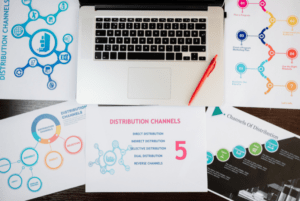
Data to Decision-Making: Key Research Steps Before Entering New Markets
Entering a new market can unlock significant business growth, but doing so without proper research can lead to costly missteps. Successful companies rely on data-driven decision-making to evaluate opportunities, minimize risks, and maximize return on investment.
In this guide, we outline the key market research steps businesses in Malaysia and beyond should take before entering a new market, ensuring that every move is backed by reliable insights.
Why Data-Driven Market Entry Matters
Market expansion is no longer based on intuition alone. Today’s competitive landscape demands:
Evidence-based strategies
Real-time market insights
Customer-centric decision-making
By transforming raw data into actionable intelligence, businesses can confidently navigate new markets with reduced uncertainty.
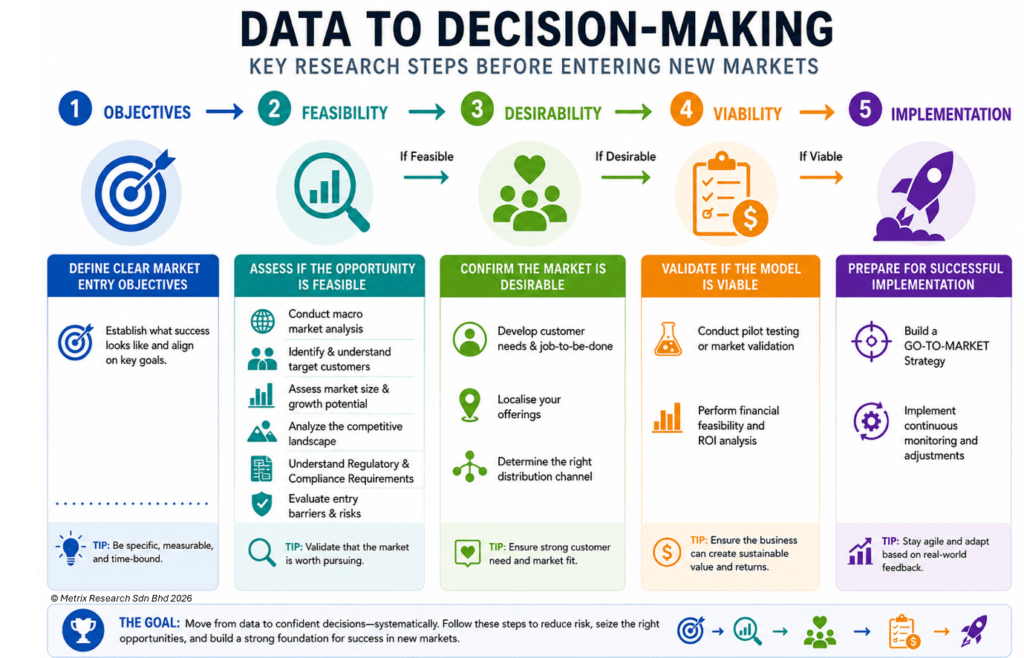
A simple illustration on key market research steps
The Guide on Key Market Research Steps
1. Define Clear Market Entry Objectives
Start with a strong strategic foundation:
What is your goal? (Revenue growth, diversification, regional expansion)
What KPIs will define success? (Market share, sales volume, brand awareness)
How does this align with your long-term business strategy?
Having clear objectives ensures your research remains focused and actionable.
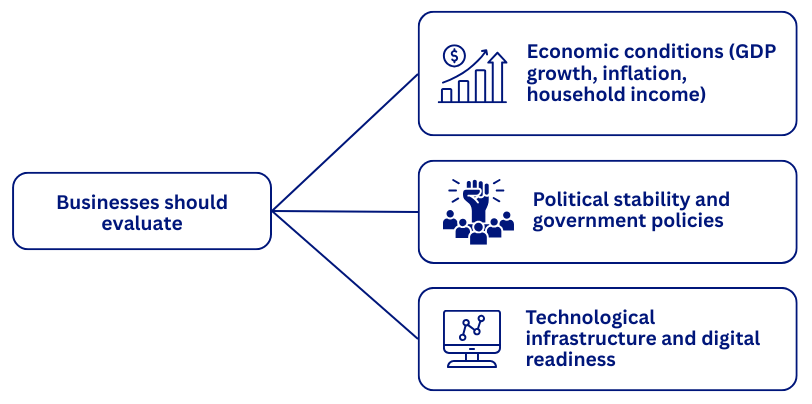
2. Conduct Macro Market Analysis
Understanding the broader environment is essential.
Using frameworks like PESTLE analysis helps identify external factors that may impact business success.
3. Identify and Understand Target Customers
A successful market entry depends on knowing your audience:
Who are your ideal customers?
What are their needs, preferences, and behaviors?
What problems remain unsolved in the market?
Having clear objectives ensures your research remains focused and actionable.
4. Assess Market Size and Growth Potential
Understanding the scale of opportunity is key:
Estimate Total Addressable Market (TAM)
Define Serviceable Available Market (SAM)
Evaluate Serviceable Obtainable Market (SOM)
Analyze industry trends, forecast growth rates, and identify demand patterns to validate market viability.
5. Analyze the Competitive Landscape
Before entering a new market, assess who you are up against:
Identify main competitors and substitutes
Study their pricing, positioning, and product offerings
Evaluate gaps in the market you can fill
A SWOT analysis helps benchmark your strengths against market challenges.
6. Understand Regulatory and Compliance Requirements
Compliance is critical when entering new markets:
Licensing and permits
Tax structures and import/export rules
Industry-specific regulations
Failure to comply can lead to fines, delays, or business restrictions.
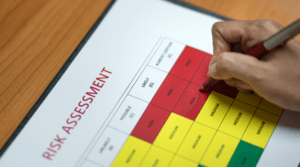
7. Evaluate Entry Barriers and Risks
Every market presents challenges. Key considerations include:
Regulatory requirements and licensing
Cultural and language differences
High entry costs or capital requirements
Supply chain and logistical complexities
Identifying risks early allows businesses to develop mitigation strategies.
8. Develop customer needs & job-to-be-done
Understanding your target customers goes beyond demographics; it requires uncovering the real problems they are trying to solve, with the product or services that you wish to offer to the market.
Identify market or customer needs:
Functional: The practical problem a customer wants to solve
Emotional: How the customer wants to feel
Social: How the customer wants to be perceived
Market or customer segmentation
Traditional segmentation (age, income, location) is useful—but not enough. Instead, segment customers based on:
Shared jobs-to-be-done
Common pain points
Similar decision-making behaviors
Map Customer Pain Points and Desired Outcomes
Identify key frustrations customers face with existing solutions
Understand what is not working in the current market
Define desired outcomes customers are seeking
Job-to-Be-Done (JTBD) framework is a powerful tool in more precise targeting, stronger market positioning and uncover market gaps & opportunities for differentiation
9. Localize Your Offering
Localization drives acceptance and brand trust:
Adapt products to local tastes and preferences
Adjust branding, messaging, and language
Be mindful of cultural sensitivities and norms
Businesses that localize effectively tend to outperform global standardization strategies.
10. Determine the Right Distribution Channels
Localization drives acceptance and brand trust:
Adapt products to local tastes and preferences
Adjust branding, messaging, and language
Be mindful of cultural sensitivities and norms
Businesses that localize effectively tend to outperform global standardization strategies.
11. Conduct Pilot Testing or Market Validation
Before full-scale expansion:
Run pilot programs or soft launches
Test product acceptance and pricing
Gather customer feedback
Using pilot insights helps refine your strategy and reduce uncertainty.
12. Perform Financial Feasibility and ROI Analysis
Make data-backed financial decisions:
Estimate setup and operational costs
Forecast revenue and profitability
Determine break-even timelines
Scenario planning helps prepare for best- and worst-case outcomes.
13. Build a Strong Go-To-Market Strategy
Your execution plan should include:
Clear brand positioning
Marketing and communication strategy
Sales and distribution roadmap
Defined timelines and KPIs
A strong go-to-market strategy ensures a smooth and impactful launch.
14. Monitor Performance and Adapt Continuously
Market entry is not a one-time effort:
Track KPIs such as sales, market share, and customer feedback
Monitor competitors and industry changes
Continuously refine strategies based on new data
Agility allows businesses to respond quickly to evolving market dynamics.
Key Takeaway: Turning Data into Confident Decisions
Expanding into a new market involves significant risk—but with the right research approach, those risks can be minimized. Businesses that invest in structured data analysis and market intelligence are better positioned to:
Identify growth opportunities
Avoid costly mistakes
Achieve sustainable success
Metrix Research is a Malaysia-based market research consultancy helping brands and businesses make better decisions through robust consumer insights and evidence-based research. Discover how we can help you measure and maximise your research impact by exploring our website or contact us today.