

Framework for Converting Research Into Action Plans
Every year, businesses commission market research, review the findings in a meeting, and then quietly move on without changing anything. The research was not wrong. The presentation was not poorly delivered.
The gap is structural. Most organisations have a process for collecting data, but no process for converting that data into decisions. Galloway Research Service calls this the “insight gap,” and it is the single biggest reason research budgets fail to show a return.
Studies are often designed around a methodology rather than a business decision, which means the findings can be technically sound yet strategically irrelevant, and a dense deck full of cross-tabulations ends up read once and never opened again. Research can answer the wrong question when a study is designed around a methodology rather than a business decision, producing findings that are technically sound but strategically irrelevant rather than direction for the business.
This problem is well documented beyond the research industry too. Global surveys on data-driven decision-making consistently find that on average only about half of the information available within organisations is actually used to support decisions, with large companies using closer to 40 percent and laggards using as little as 30 percent.
The barrier is rarely a shortage of data. It is a shortage of structure for turning data into something a manager can act on.
The framework below addresses that gap directly, with practical steps any Malaysian SME, brand team, or retail marketer can apply to the next research report that lands on their desk.
1. Start With the Decision, Not the Data
Before a single questionnaire is fielded or a focus group is scheduled, the research should be anchored to a specific decision the business needs to make.
Should we launch this SKU in hypermarkets or convenience stores first? Should we adjust pricing ahead of the festive season? Should we reposition the brand for a younger demographic? When research is commissioned around a methodology rather than a decision, it tends to produce technically sound output that nobody in the business quite knows what to do with.

Defining the decision upfront keeps the entire research effort, and everything that follows it, pointed at action rather than general curiosity.
2. Translate Findings Into "So What" Statements
Raw data points, percentages, cross-tabs, verbatims, mean nothing to a brand manager until someone connects them to a business implication. A finding that “62% of urban shoppers compare prices on their phones in-store” is only useful once it is translated into something like “our in-store pricing needs to be defensible against mobile price-checking, or we risk losing basket share to competitors with dynamic pricing apps.”
This translation step is where many research reports fall short. The Insights-to-Action Framework documented by SightX explicitly separates this stage from data collection, treating insight identification as the extraction of meaningful patterns and trends that highlight opportunities or challenges as a distinct step before any recommendation is made.
3. Prioritise by Impact and Feasibility
Not every insight deserves equal attention. Once findings are translated into implications, they need to be ranked.
A simple two-axis exercise, business impact on one side, ease of implementation on the other, separates quick wins from longer strategic bets.
Here is a simple visual:
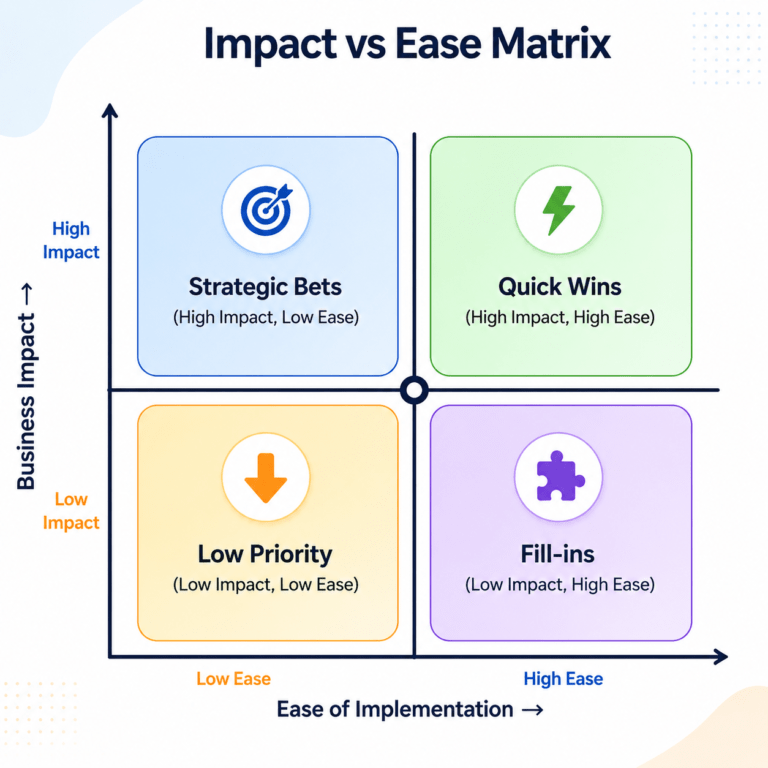
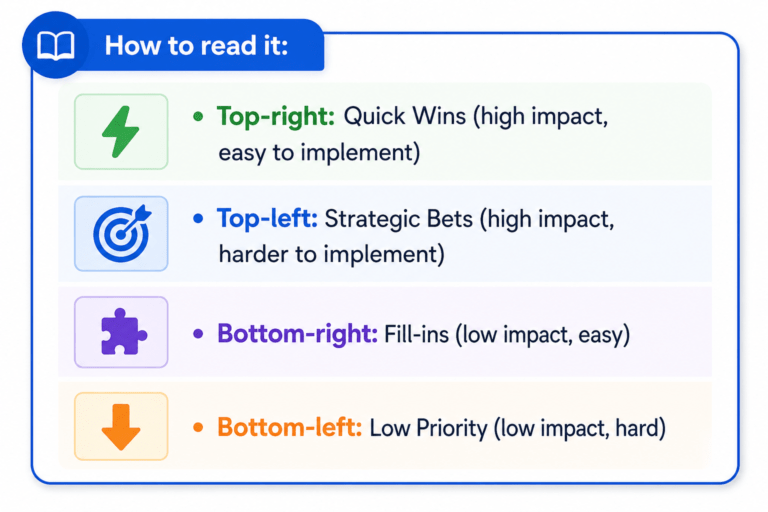
This mirrors the standard structure of insight-to-action models, which call for ranking findings based on their potential business impact and the feasibility of implementation before any strategy is developed
For a Malaysian SME (or any size of company for that matter), this step matters.
A small team cannot chase every insight at once, and prioritisation is what keeps the action plan realistic rather than aspirational.
4. Assign Clear Ownership for Every Action
An insight without an owner dies in the deck. Each recommended action needs a named individual or department responsible for execution, not a vague reference to “marketing” or “the team.” This is also where cross-functional alignment becomes critical.
Frameworks for insight activation consistently stress involving marketing, product, and sales teams to ensure holistic implementation rather than leaving the research function to push recommendations into a vacuum. If the sales team was never consulted on a pricing insight, for example, the recommendation is unlikely to survive contact with the field.
5. Set Measurable Success Metrics and Timelines
Every action item should come with a metric that defines success and a date by which it will be reviewed. “Improve shelf visibility” is not measurable. “Increase facing count for the top three SKUs by 20% within six weeks, tracked via shelf audit” is. Tying metrics to timelines is what closes the loop between recommendation and outcome, and it is the step most often skipped under time pressure, even though it is what eventually proves the research paid for itself.
6. Stress-Test Actions Against Real Constraints
A brilliant recommendation that ignores budget, headcount, supply chain, or regulatory limits is not actually actionable. Before finalising the plan, each proposed action should be checked against what the business can realistically deliver in the current quarter. This is particularly relevant in the current Malaysian operating environment, where SMEs are already navigating cost pressures and need to validate that any new initiative fits within tightened margins before committing resources to it.
7. Pilot Before Full Rollout
High-risk or high-cost recommendations benefit from a small-scale test before a full commitment. A regional trial in two states, a limited-time shelf placement, a soft launch with one retail partner, all of these let the business validate the insight against real market response before scaling spend. Piloting is cheaper than reversing a national rollout that did not work as the research predicted.
8. Build a Feedback Loop, Not a One-Time Report
The most consistent theme across recent thinking on research activation is that insight generation needs to be continuous, not a single event tied to one report.
As one industry analysis on 2025 research practice put it, market research increasingly needs to be embedded into the strategy cycle as a continuous feedback loop rather than a one-off exercise, allowing organisations to test, learn, and adapt in real time.
Tracking implementation against the original research objectives and feeding what is learned back into the next research cycle, is what separates a company that treats research as a sunk cost from one that treats it as a compounding asset.
9. Communicate Through Narrative, Not Data Dumps
Even a well-prioritised action plan can fail if it is communicated as a wall of charts. Recommendations land better as a short narrative:
- Context
- Insight,
- Recommendation
Executives need clear direction, not the full analytical trail that produced it.
A 200-slide deck filled with cross-tabulations is rarely a strategic deliverable; it is a data dump that leaves the audience unsure what to do next.
10. Standardise the Process With a Simple Template
Finally, none of the above should be reinvented for every project. A simple insight-to-action scorecard, decision being addressed, key finding, business implication, recommended action, owner, metric, timeline, gives every research project a consistent structure to move through.
Standardising the format is what makes this a repeatable framework rather than a one-time effort, and it is the difference between a research function that occasionally produces a useful report and one that reliably drives business decisions.
The Bottom Line
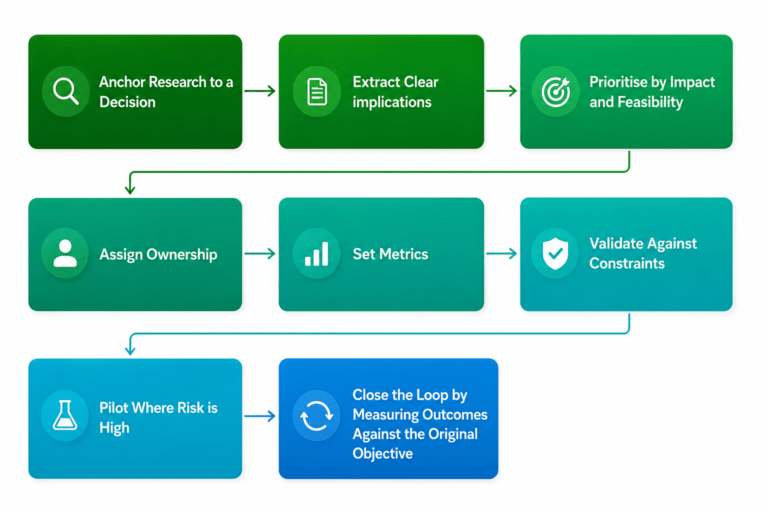
Research only creates value at the point where someone acts on it. The frameworks built around insight activation all converge on the same sequence:
For Malaysian businesses currently managing tighter margins and a fast-moving consumer landscape, this discipline is not optional polish. It is what determines whether a research investment becomes a competitive advantage or another report that nobody reopens.
Metrix Research is a Malaysia-based market research consultancy helping brands and businesses make better decisions through robust consumer insights and evidence-based research. Discover how we can help you measure and maximise your research impact by exploring our website or contact us today.
For more articles, please explore insights
Sources
- Galloway Research Service, From Data to Decisions: How to Turn Research Findings Into Actionable Strategy, October 2025
- SightX, Insights-to-Action Framework
- BARC, How Much Information Available to Companies Is Used for Decision-Making?
- Bushnote, How to Conduct Effective Market Research in 2025: Strategy, Tools and Insights