

Why Customer Behaviour Changes Over Time
Every marketer eventually asks the same uncomfortable question: why did a strategy that worked so well last year suddenly stop working? Customers who were once loyal start comparing prices elsewhere. A message that once drove conversions now falls flat. The products, the pricing, and the service may not have changed much at all, but the customer on the other end of the transaction has.

Understanding why customer behaviour shifts over time is not an academic exercise; it is the foundation of a resilient customer experience (CX) strategy, particularly for Malaysian businesses navigating a fast-digitising, multicultural, and increasingly price-conscious market.
This article unpacks the key forces behind changing customer behaviour, drawing on consumer psychology, market research, and Malaysia-specific data, and closes with what this means for how businesses, especially SMEs, should approach ongoing research and CX strategy.
1. Life Stage and Personal Circumstances Reshape Priorities
The most intuitive driver of behaviour change is simply that people’s lives change. As consumers move through different life stages, their needs, budgets, and priorities shift.
Younger consumers
Tends to prioritize technology, fashion, and entertainment
Older consumers
They place more weight on health, savings, and retirement planning
Major life events
Marriage, having children, career changes, or retirement also reorder what a person values and how much discretionary income they have to spend on it.
Economic circumstances compound this effect. Income level, employment stability, and financial confidence all influence how cautiously or freely a customer spends, and these circumstances rarely stay constant for long (CX Today, 2024).
A customer segment defined purely by demographics, i.e., age, gender, income bracket, captures a snapshot, not a trajectory. For businesses, this means customer profiles built once and left untouched will quietly go stale as the people behind them move through life.
2. Psychological Drivers: Behaviour Follows Belief
Beneath the surface of day-to-day purchasing decisions sits something more stable, and more stubborn: BELIEF. Behavioural science suggests that consumers hold a set of beliefs about the world that are psychologically deep-rooted, which is precisely why habits and routines tend to persist even when logic or new information suggests an alternative might be better (McKinsey, 2020).
This is a crucial insight for marketers: simply presenting a better product or a more rational argument is often not enough to shift behaviour, because the resistance is emotional and habitual, not logical.
Disruption changes belief, and with it, behaviour. McKinsey’s analysis of consumer behaviour during the COVID-19 pandemic found that the crisis forced consumers into new routines, and those new lived experiences reshaped their underlying beliefs about everyday activities such as grocery shopping, exercising, and socialising, in many cases permanently (McKinsey, 2020).
The broader lesson for Malaysian businesses is that behaviour change tends to follow a real disruption to daily life. Whether an economic shock, a shift in government policy, or a sudden change in convenience or access, rather than a marketing message alone.
3. Technology and Digital Transformation Compress Decision-Making
Few forces have reshaped customer behaviour as fast as the spread of the internet, e-commerce, and smartphones.
Global access to products and brands has shifted shopping from a slow, deliberate process to one that is fast and, at times, nearly impulsive, as consumers compare, discover, and purchase within the same scrolling session (Tuban, 2024). Expectations around speed, convenience, and choice have risen accordingly.
Customers now benchmark every brand experience against the fastest, most seamless one they have had recently, regardless of industry.
This pace creates a genuine challenge for market research itself. Traditional methods such as surveys, interviews, and focus groups can take weeks or months to produce findings, but by the time results are in hand, consumer tastes may already have moved on to something else (Remesh, 2024). This is one of the strongest arguments for continuous, technology-enabled research rather than the occasional, large-scale study, a point especially relevant for SMEs trying to stay agile without the research budgets of larger competitors.
4. Socio-Economic Shifts Move Faster Than Culture
It is tempting to attribute changing customer behaviour to “culture,” but the research suggests culture is actually one of the more stable variables.
Cultural indicators tend to hold steady over time, while socio-economic conditions, i.e., income levels, employment rates, and inflation, move constantly, and it is these economic fluctuations that more directly drive shifts in customer preference (arXiv, 2023).
A Malaysian household adjusting its spending in response to fuel subsidy changes or interest rate movements is a textbook example: the underlying cultural values have not shifted, but the economic context has, and behaviour follows.
5. Behaviour Is a Moving Target, Not a Fixed Segment
From a research-methodology perspective, all of the above adds up to one central implication: customer segments are not permanent.

Behaviour change varies by industry and by the specific product or service involved, which is why rigorous customer analytics increasingly track segment transitions, volatility, and continuity across multiple time periods rather than treating a segment as a fixed label applied once and reused indefinitely (Analytical Multiple Criteria Framework study, cited via arXiv). The wider academic field agrees.
Five decades of consumer behaviour research show that as the world became more globally connected, and as the pandemic accelerated the shift to digital and omnichannel marketplaces, the discipline of consumer research itself had to keep evolving to stay accurate (ScienceDirect, 2024).
For a business, the practical takeaway is that a customer persona built two or three years ago should be treated as a hypothesis to be retested, not a fact to be relied upon indefinitely.
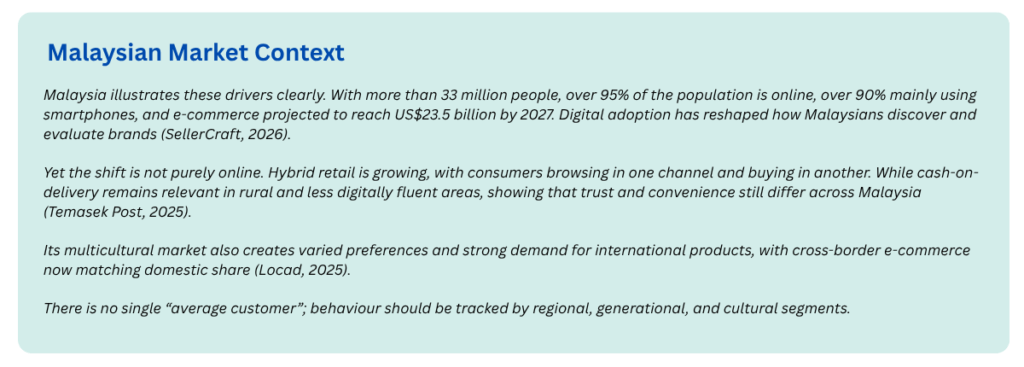
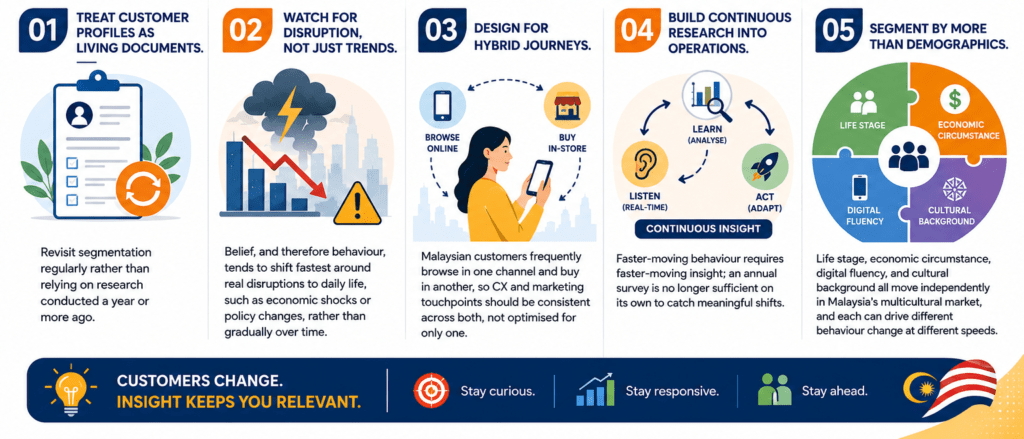
What This Means for Malaysian Marketers and Strategists
Customer behaviour doesn’t stand still. Here’s how to stay ahead:
Metrix Research is a Malaysia-based market research consultancy helping brands and businesses make better decisions through robust consumer insights and evidence-based research. Discover how we can help you measure and maximise your research impact by exploring our website or contact us today.
For more articles, please explore insights
References
CX Today. (2024). Behind the Choices: Exploring the Four Key Drivers of Consumer Behavior. https://cxtoday.com/loyalty-management/behind-the-choices-exploring-the-four-key-drivers-of-consumer-behavior
Locad. (2025). E-commerce in Malaysia – 2025 Trends And Insights. https://golocad.com/blog/e-commerce-in-malaysia-2025-trends/
McKinsey & Company. (2020). Understanding and shaping consumer behavior in the next normal. https://www.mckinsey.com/business-functions/growth-marketing-and-sales/our-insights/understanding-and-shaping-consumer-behavior-in-the-next-normal
Remesh. (2024). Consumer Behavior: Navigating Rapid Changes in Buyer Behavior. https://www.remesh.ai/resources/consumer-behavior
ScienceDirect. (2024). More than 50 years of consumer behavior research: What will the future look like? https://www.sciencedirect.com/science/article/abs/pii/S0148296324005319
SellerCraft. (2026). Malaysia’s Digital Retail Outlook 2025–2026. https://sellercraft.co/malaysia-digital-retail-outlook-2025-2026/
Temasek Post. (2025). Malaysia Consumer Trends 2025: How Malaysians Are Spending and Shopping in a Changing Economy. https://www.temasekpost.com/posts/malaysia-consumer-trends-2025-how-malaysians-are-spending-and-shopping-in-a-changing-economy-iumk3
Tuban, D. (2024). How Customer Behavior Is Changing Over Time: Generational Differences, Digital Transformation, and User Habits. Medium. https://medium.com/@damlatuban/how-customer-behavior-is-changing-over-time-generational-differences-digital-transformation-and-8f6f38f80568
arXiv. (2023). Towards Global, Socio-Economic, and Culturally Aware Recommender Systems. https://arxiv.org/pdf/2312.05805
arXiv. (2026). An Analytical Multiple Criteria Framework for Temporal and Dynamic Business-to-Business Customer Segmentation in Manufacturing. https://arxiv.org/pdf/2605.17151