

Aligning Marketing and Strategy Teams with Insights: A Practical Playbook for Turning Market Research
Why consumer and market research must sit at the heart of cross-functional alignment
Why alignment breaks down even when you have plenty of data
Most organisations do not struggle to collect information. They struggle to turn it into a decision that multiple teams can stand behind. When marketing and strategy are not aligned, even a well-run market research project can trigger internal debate, delayed actions, and repeated requests for clarification from senior management.
- Conflicting success measures across departments and reporting cycles
- Unclear ownership for drivers, actions, and follow-up tracking
- Low confidence in results due to sampling, contactability, or response rate concerns
- Reports that are too technical for decision makers with limited time
Different success measures and timelines
In today’s competitive business environment, one of the most persistent challenges facing organisations is not a lack of data; it is a lack of alignment.
- Marketing teams generate campaigns. They often optimise for short cycles, i.e. campaign performance, channel conversion, and lead quality.
- Strategy teams build plans. Tend to focus on broader outcomes, i.e. growth priorities, segment focus, and resource allocation
- Research teams produce insights. They focus on the credibility and accuracy of research outcomes in providing insights.
Yet far too often, these three functions operate in isolation, each with its own priorities, metrics, and language. The result is an organisation that moves slowly, spends inefficiently, and misses the consumer signals that could have made the difference.
For Malaysian businesses operating in fast-moving sectors such as FMCG, retail, and financial services, where consumer preferences are shaped by cultural diversity, digital adoption, and economic sensitivity, this misalignment is especially costly.
The solution lies not in more data, but in using insights as the connective tissue that binds marketing execution to strategic direction.
This article sets out the key principles and practical approaches for aligning marketing and strategy teams through the disciplined use of consumer and market insights.
1. The Alignment Gap Is Real — and Costly
Most senior leaders believe their teams are aligned. The data suggests otherwise.
The alignment perception gap: senior leaders may believe sales and marketing are in sync, while frontline teams often experience day-to-day friction that slows execution and weakens market responsiveness.
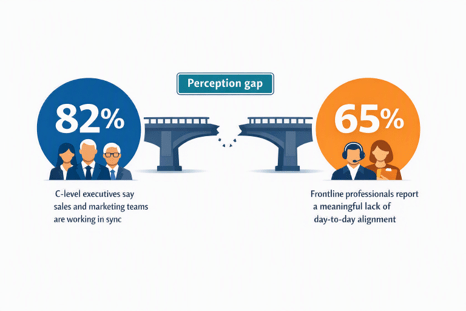
This perception gap is not a minor inconvenience. It is the root cause of wasted budgets, duplicated effort, and missed market opportunities.
“Aligned organisations achieve 2.4x higher revenue growth and 2x higher profitability growth than misaligned peers.”
— Forrester, 2024 Tweet
For Malaysian companies, the alignment challenge is compounded by the speed of market change. Consumer behaviour is shifting rapidly, shaped by the rise of e-commerce, inflationary pressures, and the country’s multicultural demographic landscape. Without a shared understanding of the consumer — grounded in rigorous research — marketing and strategy teams will continue pulling in different directions, even when they believe they are pursuing the same goal.
2. Insights Must Become the Common Language Across Teams
The most effective organisations do not treat market research as a deliverable owned by a single department. Instead, they embed insights into the fabric of how all teams make decisions.
When consumer data becomes the shared reference point for marketing, strategy, product, and commercial teams alike, it ceases to be a document and becomes a decision-making culture.
IE Business School’s 2025 analysis of marketing best practices highlights this shift clearly: building a truly data-driven culture requires aligning people, processes, and platforms around shared insights. When data becomes the common language, marketing evolves from a reactive execution function into a strategic growth engine.
This is a particularly important shift for organisations in Malaysia, where the pressure to demonstrate ROI from marketing spend is increasing, and the tolerance for intuition-based decision-making is declining.
In practical terms, this means research findings must be translated and communicated in ways that resonate with different audiences.
- A brand manager needs insights framed around consumer behaviour and messaging effectiveness.
- A CEO needs insights framed around market opportunity and competitive risk.
The underlying data may be the same, but the translation must be deliberate and audience-specific.
3. Align Research Objectives to Business Priorities from the Start
One of the most common and avoidable causes of misalignment is the commissioning of research without a clear line of sight to strategic decisions. When research is treated as a standalone project — rather than a component of an integrated strategic process — its findings are often received too late, framed too narrowly, or disconnected from the questions that matter most to decision-makers.
Emergen Research’s analysis of strategic investment decision-making identifies this as a critical failure point: all too often, market research programmes are disconnected from strategy, leading to wasted efforts and lost opportunities. Best-in-class organisations recognise the importance of connecting research initiatives, strategic priorities, and investment decisions into an integrated plan.
The solution begins at the briefing stage. Before any research methodology is selected or fieldwork is commissioned, research teams should engage senior stakeholders — from both marketing and strategy — to identify the specific decisions the research must inform. Factworks, a leading insights consultancy, recommends conducting stakeholder interviews at the outset to align research goals with business priorities. Providing interim findings and hosting working sessions throughout the project keeps stakeholders engaged and ensures that insights are not merely received, but actively embraced.
“Every market research plan should directly tie back to overarching business objectives and strategy targets. Research projects are not isolated efforts but part of an integrated programme to address what matters most to the business.”
— Emergen Research Tweet
4. Establish Shared Goals and Metrics Between Teams
A significant driver of cross-functional misalignment is the absence of shared performance metrics.
- Marketing teams typically measure campaign performance, brand awareness, and lead generation.
- Strategy teams focus on revenue growth, market share, and competitive positioning.
When these metrics do not connect, teams optimise for different outcomes and lose sight of the bigger picture.
Research from multiple sources confirms that shared metrics are a prerequisite for alignment. Organisations with shared goals, service-level agreements, integrated dashboards, and regular joint planning meetings are far more likely to hit revenue targets and avoid pipeline gaps. Furthermore, aligned organisations achieve 36% higher customer retention and 20% higher customer lifetime value over the full customer lifecycle (Forrester).
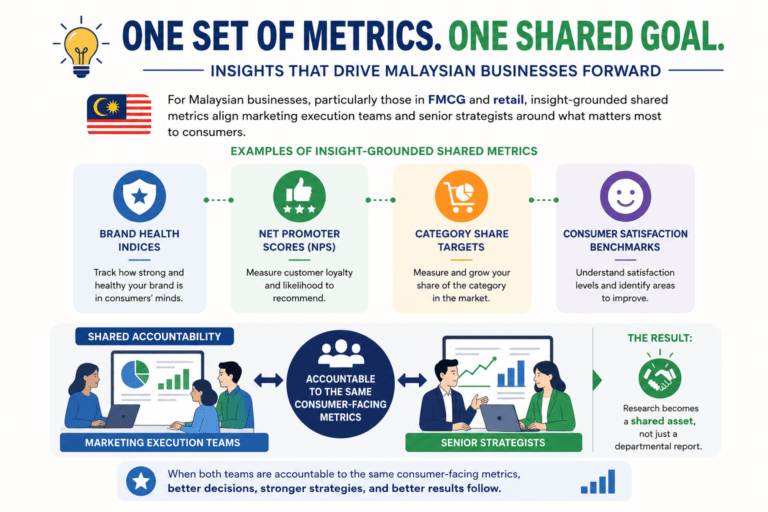
For Malaysian businesses, particularly those in FMCG and retail, insight-grounded shared metrics might include brand health indices, net promoter scores, category share targets, or consumer satisfaction benchmarks — all of which are meaningful to both marketing execution teams and senior strategists. When both teams are accountable to the same consumer-facing metrics, the research that generates those metrics becomes a shared asset rather than a departmental report.
5. Build Structured Feedback Loops Between Teams
Alignment is not a destination — it is an ongoing process. Even organisations that invest in strong research at the start of a planning cycle can drift out of alignment as campaigns roll out, market conditions shift, and consumer behaviour evolves. Sustained alignment requires structured, recurring mechanisms for sharing insights across teams.
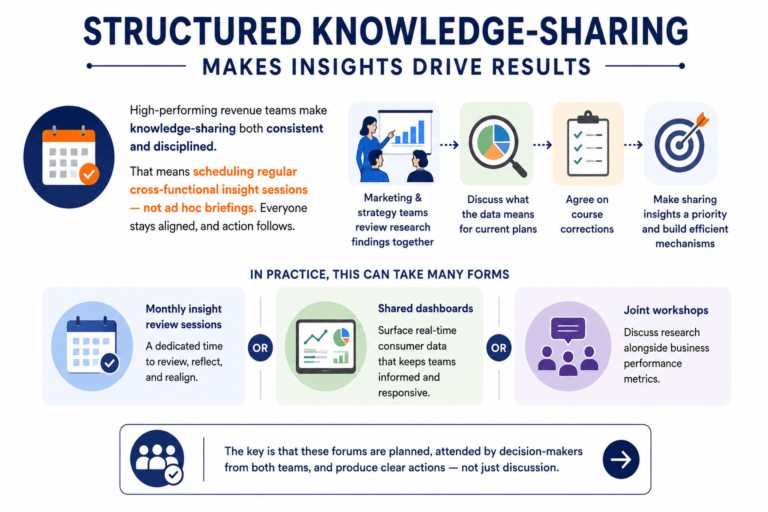
Outreach’s analysis of high-performing revenue teams highlights that structured knowledge-sharing must be both consistent and disciplined. This means scheduling regular cross-functional insight sessions — not ad hoc briefings — where marketing and strategy teams review research findings together, discuss what the data means for current plans, and agree on course corrections. The goal is to make sharing insights a priority and build efficient mechanisms for doing so, rather than relying on informal channels.
In practice, this might take the form of monthly insight review sessions, shared dashboards that surface real-time consumer data, or joint workshops where research is discussed alongside business performance metrics. The key is that these forums are planned, attended by decision-makers from both teams, and produce clear actions — not just discussion.
6. Democratise Insights Across the Organisation
One of the most significant barriers to alignment is the concentration of insight access within a single function. When research findings are locked inside a research team’s reports — or buried in lengthy PowerPoint decks that few people read in full — the potential for those insights to shape decisions across the organisation is dramatically limited.
Qualtrics’ 2026 Market Research Trends Report, drawing on data from over 3,000 researchers across 17 countries, identifies the democratisation of insights as one of the defining trends reshaping the industry. The emergence of AI-powered tools and conversational analytics is enabling product managers, marketing teams, and executives to access research-grade insights without waiting for a formal report — closing the gap between what stakeholders need and what research teams can deliver. Notably, 13% of researchers now identify democratising insights as the single biggest benefit of using AI tools in their work.
“By closing the gap between what stakeholders want and what research teams can deliver, AI is solving two long-standing challenges in market research: researcher capacity and internal alignment.”
— Qualtrics, 2026 Market Research Trends Report Tweet
For market research companies and their clients in Malaysia, this has practical implications. Insight outputs should be designed for accessibility — not just comprehensiveness. Summary dashboards, executive-level insight briefs, and visual storytelling formats help ensure that research reaches the people who need it, in a format they can act on quickly.
7. Translate Insights into Action — Not Just Reports
Producing a high-quality research report is a necessary but insufficient step toward alignment. The value of research is only realised when it changes decisions. This requires a deliberate translation layer between the findings themselves and the strategic or marketing actions they should inform.
Factworks CEO Nadja Böhme articulates this challenge directly:
“Market research has always been about uncovering truths that drive better decisions, but in today’s environment, it’s equally about proving its worth in measurable terms. This means not only delivering insights but also connecting those insights to tangible business outcomes — whether that’s increasing revenue, reducing costs, or improving customer retention.”
Clients and internal stakeholders are increasingly asking for a clearer connection between research findings and measurable business outcomes — and this expectation is only growing.
For research teams, this means moving beyond descriptive reporting to interpretive and prescriptive communication: here is what the data shows, here is what it means for your strategy, and here is what we recommend you do next.
Emergen Research reinforces this point through a concrete example: a fast-food chain struggling with stale brand perceptions may leverage customer surveys, choice modelling, and transaction analysis to pinpoint menu innovation as a high-leverage opportunity with younger consumers — leading to targeted investment in product R&D and brand repositioning.
This is research informing strategy, with marketing execution to follow.
8. Use Buyer Personas and Consumer Profiles as Unifying Tools
One of the most practical and powerful tools for aligning marketing and strategy teams around a shared consumer understanding is the buyer persona, a structured, insight-driven profile of the target customer. When built from rigorous qualitative and quantitative research, personas serve as a common reference point that both teams can use to guide their respective work.
According to Salesforce’s State of Sales 2024 report, 86% of buyers are more likely to engage when they feel their goals are understood. INFUSE’s 2025 research further highlights that a shared knowledge of buyer behaviour is essential for guiding messaging and content usage across the entire sales cycle.
Importantly, this knowledge must be shared across teams, not siloed within marketing.
For Malaysian businesses, consumer personas add layers of complexity and richness. A well-constructed persona for a Malaysian FMCG brand must account for language preference, ethnicity, religious observance, urban-rural divide, and the influence of festivals such as Hari Raya, Chinese New Year, and Deepavali on purchasing behaviour.
When both the marketing team and the strategy team are working from the same consumer persona, built on real research, not assumptions, their decisions are far more likely to be complementary than contradictory.
9. Build a Culture That Embraces Insight-Led Decision-Making
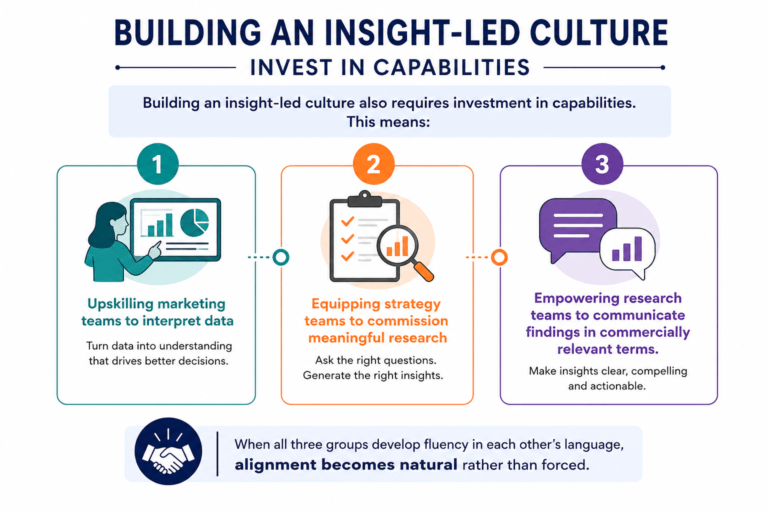
Technology, processes, and personas are all important enablers of alignment, but none of them will be sustained without a cultural foundation that values evidence over intuition.
An insight-led culture is one where leaders model the behaviour they want to see: consulting research before making decisions, referencing data in strategic conversations, and recognising teams that use evidence to course-correct.
The Qualtrics 2026 Market Research Trends Report offers a stark warning for organisations that resist this shift. Research teams that confidently embrace new methodologies and tools are earning greater strategic influence and securing larger budgets. Meanwhile, 32% of traditional research teams report flat budgets and declining organisational credibility.
The gap between those who use insights strategically and those who do not is widening, and fast.
Conclusion: Insights as the Bridge Between Marketing and Strategy
The organisations that will lead their categories in Malaysia over the next decade will not be those with the most data — they will be those that use data most effectively to align the people responsible for growth. Marketing teams need a strategy’s direction. Strategy teams need marketing’s consumer proximity. And both need research as the foundation that grounds their decisions in reality.
Aligning marketing and strategy teams with insights is not a one-time project. It is an ongoing practice that requires the right research frameworks, the right communication of findings, shared metrics, and most importantly, a leadership commitment to building a culture where insights drive decisions at every level.
For Malaysian businesses navigating a complex, multicultural, and rapidly evolving marketplace, this is not optional. It is the foundation of sustainable competitive advantage.
Metrix Research is a Malaysia-based market research consultancy helping brands and businesses make better decisions through robust consumer insights and evidence-based research. Discover how we can help you measure and maximise your research impact by exploring our website or contact us today.
For more articles, please explore insights
References & Key Sources
- Forrester (2024). Q2 2024 Sales and Marketing Alignment Survey.
- Mural (2025). GTM Alignment Gap Study.
- Qualtrics (2026). Market Research Trends Report. Based on insights from over 3,000 researchers across 17 countries.
- Factworks / Greenbook (2025). 4 Trends Shaping Market Research in 2025.
- Emergen Research (2024). Strategic Insights: The Intersection of Market Research and Investment Decision-Making.
- IE Business School / Uncover IE (2025). Aligning Marketing Strategy with Business Goals: Best Practices 2025.
- INFUSE (2025). 7 Sales and Marketing Alignment Best Practices.
- Outreach (2025). How to Know if Sales and Marketing Teams Are Aligned.
- Aberdeen Group. Revenue Performance and Sales-Marketing Alignment.
- Salesforce (2024). State of Sales Report.