

Calculating Research Return on Investment
Every ringgit your business spends should be accountable. Marketing budgets are scrutinised, operations costs benchmarked, and headcount justified with productivity metrics. Yet market research, one of the most consequential business investments is still often approved on instinct and judged by gut feel.
That needs to change.
For brand managers, retail strategists, and business owners, calculating research ROI is more than financial hygiene. It is how you build a culture of evidence-based decision-making that outperforms the competition.
This article explains what research ROI is, how to measure it, and how to make the case for it — even when the numbers are not immediately obvious.
What Is Research ROI?
Return on Investment (ROI) is a straightforward concept: divide the net benefit of an activity by its cost, multiply by one hundred, and you get a percentage that tells you how much value was generated per ringgit spent.
Applied to market research, the formula looks like this:
Research ROI (%) = [(Value Generated – Research Cost) / Research Cost] × 100
Simple enough in theory. The complexity lies in defining what “value generated” actually means for research, because unlike a sales campaign or a product launch, research does not generate revenue directly. It generates better decisions — and better decisions generate revenue, reduce waste, and protect against costly mistakes.
This is the critical reframe that every business leader needs to make.
Research is not an expense line. It is decision infrastructure.
Why Research ROI Matters More Than Ever in Malaysia
The Malaysian business environment has grown increasingly competitive. Regional players from Singapore and Indonesia are entering local markets with sophisticated consumer intelligence. Domestic brands are under pressure from e-commerce disruption and shifting shopper behaviour. And with a multicultural consumer base spanning Malay, Chinese, Indian, and other communities, each with distinct purchasing motivations, media habits, and festive cycles — the cost of a poorly targeted decision is amplified.
Add to this the economic pressures Malaysian businesses have faced in recent years, including currency fluctuations, rising input costs, and cautious consumer spending, and budget accountability has never been more important. Research departments and agency partners are increasingly being asked to justify their expenditure — not just deliver findings. The businesses that will thrive are those that treat research not as a discretionary spend, but as a competitive asset. And to protect that asset, you need to be able to articulate its value in the language of business: revenue, risk, and return.
The Building Blocks: What Goes Into Research Cost?
Before you can calculate ROI, you need a complete picture of what your research actually costs. Many organisations undercount because they focus only on the agency invoice or the survey tool subscription. A true cost accounting should include:
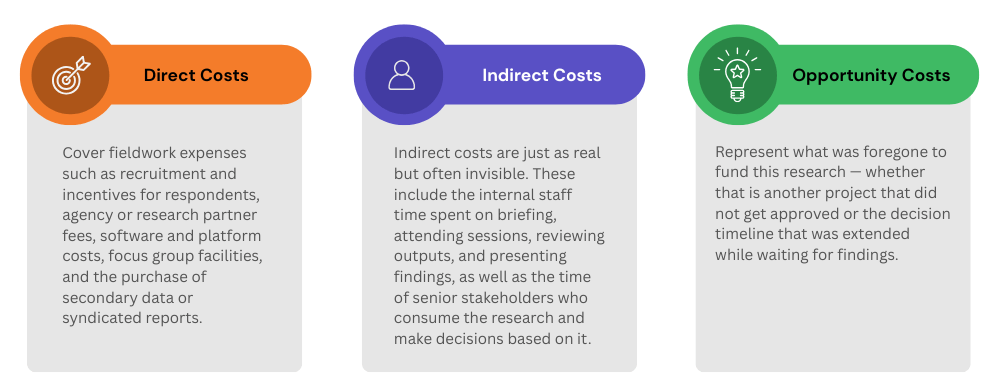
Getting this full picture matters because it ensures your ROI calculation is honest, and because it helps you identify where research processes can be made more efficient without sacrificing quality.
The Other Side of the Equation: How Research Creates Value
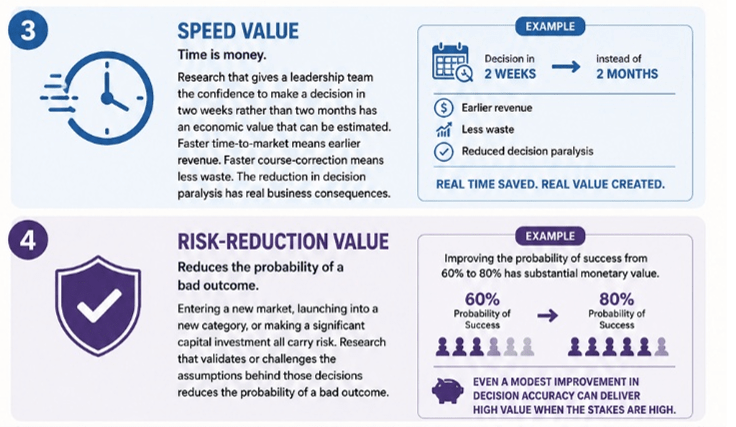
This is where many organisations struggle. Value from research is real, but it rarely arrives with a clearly labelled price tag. It comes in four main forms.

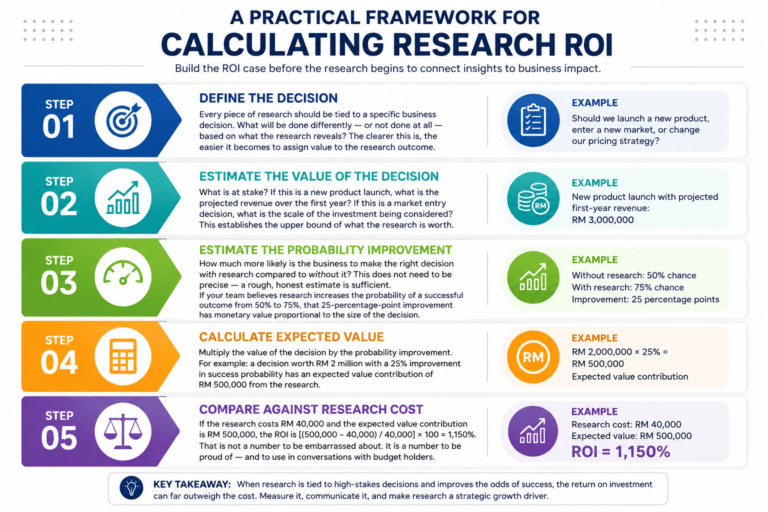
A Practical Framework for Calculating Research ROI
Rather than waiting until after a project is complete and trying to reverse-engineer the value, the most effective approach is to build the ROI case before the research begins. Here is a step-by-step framework.
Metrics and Proxies When Exact Figures Are Unavailable
Not every research project lends itself to clean financial modelling. Brand health tracking, customer satisfaction research, and cultural insight work generate value that is diffuse and long-term. In these cases, use proxies and leading indicators to demonstrate impact.
Revenue per research ringgit spent gives a portfolio-level view of how research investment correlates with business performance over time. Decision adoption rate — the proportion of research recommendations that are actually implemented — is a measure of research quality and organisational trust. Decision confidence scores, captured before and after research is shared, quantify how much clarity the research provides to decision-makers. Research-informed decisions that met or exceeded their KPIs, tracked over time, build a compelling institutional case for research investment.
The goal is not to manufacture precision where none exists. It is to replace vague assertions about research value with a structured, consistent way of demonstrating it.
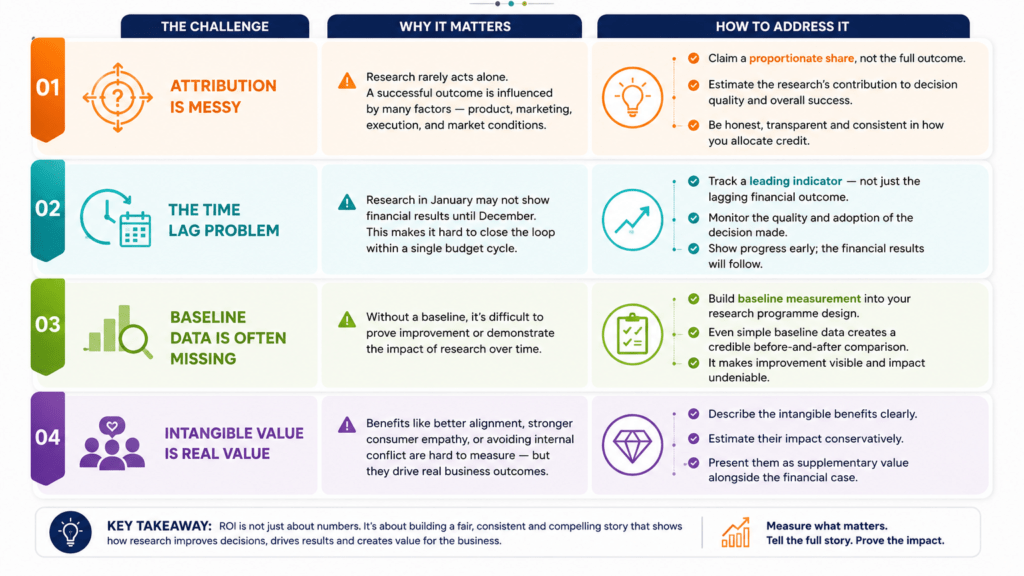
Common Challenges and How to Address Them
Real challenges are normal. The key is knowing how to handle them and still prove research ROI.
Making the Internal Case for Research Investment
For research leaders and agency partners, the ability to articulate research ROI is a commercial and professional competency. Here is how to build that case effectively.
Frame research as decision insurance, not overhead. Every major business decision carries risk. Research is a relatively low-cost mechanism for reducing that risk. A research investment equivalent to one or two percent of the total cost of the decision it informs is, by any rational standard, a bargain.
Build a research impact log. Start tracking the decisions your research has informed, the recommendations that were adopted, and the outcomes that followed. Over time, this becomes an evidence base that speaks for itself.
Speak the language of your audience. Finance directors respond to ROI calculations and risk-adjusted returns. Brand directors respond to market share and consumer connection. CEOs respond to competitive advantage and strategic clarity. The research story is the same — the framing should shift to match who is listening.
Set expectations at the proposal stage. Rather than delivering a report and hoping the client sees its value, articulate the expected impact of the research at the point of briefing. This creates shared accountability and makes the ROI conversation a natural conclusion rather than an uncomfortable afterthought.
Conclusion: Research Is Not a Cost. It Is a Multiplier.
The businesses that invest consistently in market research do not do so because they have surplus budgets. They do so because they understand that good information is a force multiplier on every other investment they make. When you know your consumer, your decision-making gets faster, sharper, and more confident. When you know your market, your capital goes to the right places.
Calculating research ROI is not about justifying a line item. It is about building a language that connects insight to impact — and positioning your research function, whether internal or external, as an indispensable part of how your business wins.
The cost of not knowing has always been higher than the cost of finding out. Now you have the framework to prove it.
Metrix Research is a Malaysia-based market research consultancy helping brands and businesses make better decisions through robust consumer insights and evidence-based research. Discover how we can help you measure and maximise your research impact by exploring our website or contact us today.
For more articles, please explore insights
References
- National Business Research Institute (NBRI). Calculating ROI on Market Research. https://www.nbrii.com/blog/calculating-roi-market-research/
- Department of Statistics Malaysia (DOSM). Micro, Small & Medium Enterprises (MSMEs) Performance 2024. Published July 2025. https://www.dosm.gov.my/portal-main/release-content/micro-small–medium-enterprises-msmes-performance-2024
- Gartner. Gartner Says Bad Financial Decisions by Managers Cost Firms More Than 3 Percent of Profits. December 2018. https://www.gartner.com/en/newsroom/press-releases/2018-12-20-gartner-says-bad-financial-decisions-by-managers-cost-firms-more-than-3-percent-of-profits
- CaliberMind. The Hidden Costs of Bad Marketing Data. September 2024. https://calibermind.com/articles/hidden-costs-of-bad-marketing-data/
- Suzy. How to Calculate Market Research ROI and Prove the Value of Insights. July 2025. https://www.suzy.com/blog/how-to-calculate-market-research-roi
- CLARITY Research and Strategy. Poor Market Research: The Hidden Costs of Ignoring Data. April 2025. https://clarity-us.com/poor-market-research/
- DigitalOcean / McKinsey. Data-Driven Decision-Making: How to Use Quantitative Insights for Business Success. https://www.digitalocean.com/resources/articles/data-driven-decision-making
- B2B International. Measuring & Maximising The ROI Of Market Research. June 2022. https://www.b2binternational.com/publications/research-for-decisions/
- Quirk’s Marketing Research Review. Determining the Return on Research Can Be Tricky But Is Worthwhile. January 2012. https://www.quirks.com/articles/determining-the-return-on-research-can-be-tricky-but-is-worthwhile
- VisioneerIT / IDG Enterprise. The Benefits of Data-Driven Decision Making. https://www.visioneerit.com/blog/data-driven-decision-making
.