

From Data to Delivery: Embedding Primary Research Across Malaysia’s Policy Lifecycle
Why Data‑Driven Policy Matters Today
Malaysia’s public sector operates in an environment of fiscal pressure, rising citizen expectations, and increasingly complex social and economic challenges. Issues such as income inequality, climate risks, public health demands, and regional development gaps require policies that are precise, responsive, and effective.
Traditional policymaking, often based on precedent or limited consultation, struggles to meet these demands. Data‑driven policymaking offers an alternative approach: using systematic evidence across the entire policy cycle to design, implement, and improve public programmes. In Malaysia, this approach aligns closely with national initiatives such as the Malaysia Digital Economy Blueprint (MyDIGITAL), which promotes smarter, more accountable, and citizen‑centered governance.
“Data‑driven policymaking shifts decisions from assumption‑based to evidence‑led, improving both effectiveness and accountability.”
What Is Data‑Driven Policy Making?
Data‑driven policy making involves the structured use of quantitative data—administrative records, surveys, and real‑time indicators, together with qualitative insights to inform decision‑making. This approach supports:
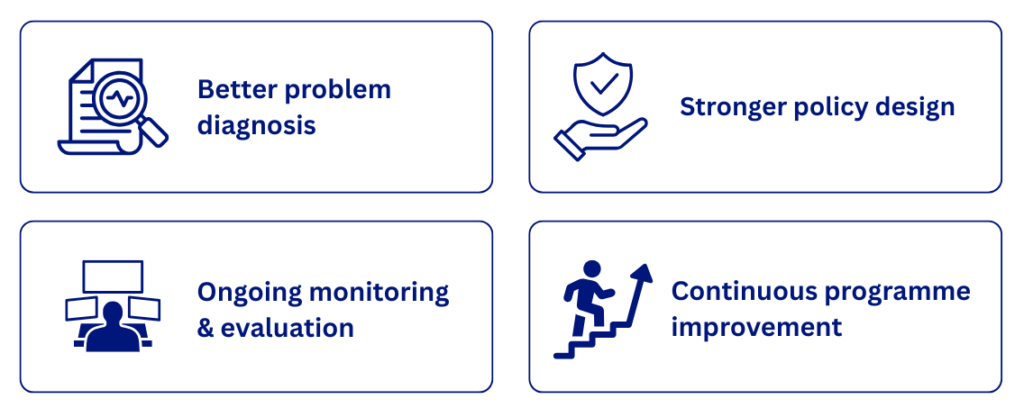
The OECD highlights that governments that systematically embed evidence into policymaking processes achieve more coherent, efficient, and resilient policy outcomes.
Malaysia’s Shift Towards Data‑Driven Governance
Malaysia has made substantial progress in building the foundations for data‑driven government.
Key developments include:
- MyDIGITAL, which sets a long‑term roadmap for digital government and analytics‑enabled policymaking
- Open data platforms such as data.gov.my and OpenDOSM, providing high‑frequency and granular public sector data
- The Public Sector Data Digitalisation Policy and MyGDX, enabling secure, structured data sharing across agencies
Together, these initiatives enable ministries to move from fragmented, siloed information toward more integrated policy responses.
“Without interoperable data systems, whole‑of‑government policy responses are difficult to achieve.”
Improving Programme Targeting and Resource Allocation
One of the clearest benefits of data‑driven policymaking is improved targeting of public programmes.
By analysing income data, demographic indicators, and geographic characteristics, policymakers can:
- Identify priority groups more accurately
- Reduce benefit leakages
- Minimise exclusion of eligible recipients
- Allocate resources more efficiently
Research on Malaysian public organisations shows that data analytics strengthens strategic decision‑making and improves public sector efficiency when embedded into planning processes.
Turning Data into Action: The Role of Targeted Primary Research
Administrative and open datasets show where problems exist—but they rarely explain why they occur or how policies should be adjusted. This is where targeted primary research becomes critical.
Primary research methods include:
- Stakeholder and Rakyat surveys
- Focus group discussions
- Interviews with frontline officers or Key Opinion Leaders
- Field observations and pilot studies
These approaches generate context‑specific insights that quantitative data cannot capture, particularly in Malaysia’s diverse social and regional landscape.
Primary research helps policymakers:
- Refine problem definitions
- Identify behavioural and operational barriers
- Design policies that are operationally feasible
- Test interventions before scaling
“Data identifies the problem. Primary research explains the solution.”
When embedded into monitoring and evaluation systems, ongoing primary research also enables adaptive policymaking, allowing programmes to evolve as conditions change.
Case Study
Malaysia’s experience shows that targeted primary research is most effective when embedded throughout the full policy lifecycle, rather than treated as a one-off consultation exercise. The case below illustrate how surveys, interviews, focus groups, and participatory research translate national policy intent into operationally realistic solutions.
Policy Lifecycle Framework
Five key stages where primary research adds value:
- Problem Identification & Diagnosis
- Policy Design & Co‑creation
- Pilot Testing & Prototyping
- Implementation & Delivery
- Monitoring, Evaluation & Adaptation
Case
Undi18 & Youth Political Participation (GE15 Context)
Policy issue: Concern that lowering the voting age to 18 (Undi18) would result in disengaged or uninformed voters.
Primary research methods used:
- Structured focus group discussions across multiple states
- Qualitative exploration of motivations, trust, and information channels
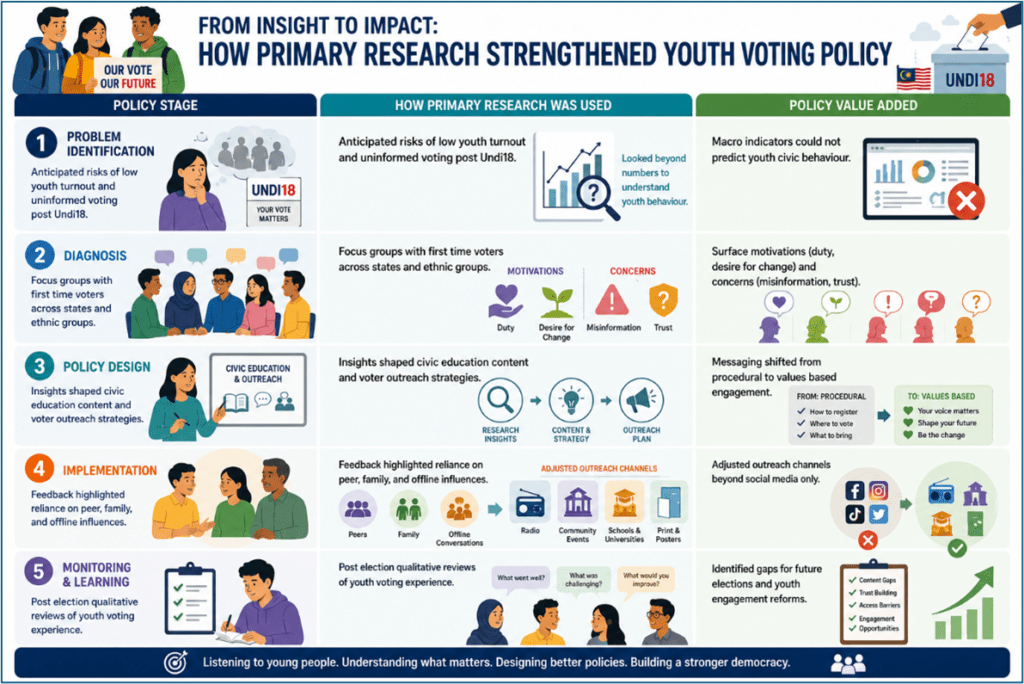
Key insight: Primary research reframed youth voters from a risk group to a motivated but support‑constrained constituency.
Policy impact:
Findings informed youth-targeted civic education, adjustments in Election Commission outreach messaging, and greater emphasis on trusted peer and family networks rather than purely digital campaigns. This helped policymakers move beyond assumptions derived from turnout statistics alone
Primary Research as the Missing Middle
Across Malaysian cases, primary research functions as a translation layer between national data systems and local delivery realities.
National Data | Flags the Problem |
Primary Research | Explains Context & Behaviour |
Policy Design | Becomes Feasible |
Pilots | Reduce Risks |
Adaptive Delivery | Improves Outcome |
“Data tells us what is happening. Primary research tells us what to do next.”
Why This Matters for Malaysia
In a socio‑economically diverse and administratively decentralised system:
- National averages often mask local variation
- Uniform solutions struggle in heterogeneous contexts
- Implementation capacity varies widely across districts
Embedding targeted primary research throughout the policy lifecycle enables:
- Smarter problem definitions
- More legitimate and trusted interventions
- Lower policy failure rates
- Stronger state–citizen relationships
Monitoring, Evaluation, and Continuous Improvement
Data‑driven policymaking strengthens monitoring and evaluation by linking inputs, outputs, and outcomes with measurable indicators. Dashboards and performance systems allow early detection of issues, while qualitative feedback supports interpretation and corrective action.
Evaluations of Malaysian social programmes show that data‑based M&E systems improve accountability and learning, especially when paired with stakeholder engagement.
Transparency, Accountability, and Public Trust
Evidence‑based decisions enhance transparency by providing clear justifications for policy choices and resource allocation. Open data initiatives further enable public scrutiny and independent analysis.
Studies of open government data in Malaysia show trust gains are strongest when data quality, governance, and ethical safeguards are well managed.
“Transparency is strongest when data is not only open, but well‑governed and well‑explained.”
Challenges and Enablers
Key challenges remain:
- Fragmented data systems
- Uneven analytical capacity
- Privacy and governance concerns
- Cultural resistance to evidence‑based overrides
Legal and academic analyses caution that responsible data use must be supported by accountability and fairness safeguards. OECD experience shows that sustained leadership commitment and institutionalised evidence use are critical success factors.
Conclusion: From Data to Better Public Outcomes
Data‑driven policymaking represents a fundamental shift in how public programmes are conceived and delivered in Malaysia. When combined with targeted primary research, it ensures that policies are not only analytically sound but operationally practical and citizen‑centred.
As Malaysia continues its digital transformation, embedding both quantitative data and qualitative evidence into everyday policy making will be essential to delivering public programmes that are effective, inclusive, and trusted.

Metrix Research is a Malaysia-based market research consultancy helping brands and businesses make better decisions through robust consumer insights and evidence-based research. Discover how we can help you measure and maximise your research impact by exploring our website or contact us today.
For more articles, please explore insights
Sources:
- Malaysia Digital Economy Blueprint (MyDIGITAL)
- Building Capacity for Evidence‑Informed Policy‑Making by OECD
- Data.gov.my
- Open.dosm.gov.my
- Digital Ministry launches national data-sharing policy to support, Malay Mail, Feb 2026
- Enhancing Strategic Decision-Making in Malaysian Public Organizations: The Role of Big Data Analytics and Continuous Improvement, UiTM, 2025
- Malaysia FGD 2023, International Republican Institute (IRI)
- Malaysia 2022-2025 Country Programme Evaluation, UNICEF 2024
- The state of open government data implementation in Malaysia Government Agencies, UIAM 2022