

How Concept Testing Reduces Launch Risk
Launching a new product feels a bit like betting on a horse race after only seeing it in the paddock. Everyone in the room believes in the idea — the founder, the product team, the investors. But belief isn’t evidence, and the market has a long, well-documented history of rejecting products that internal teams were certain would succeed.
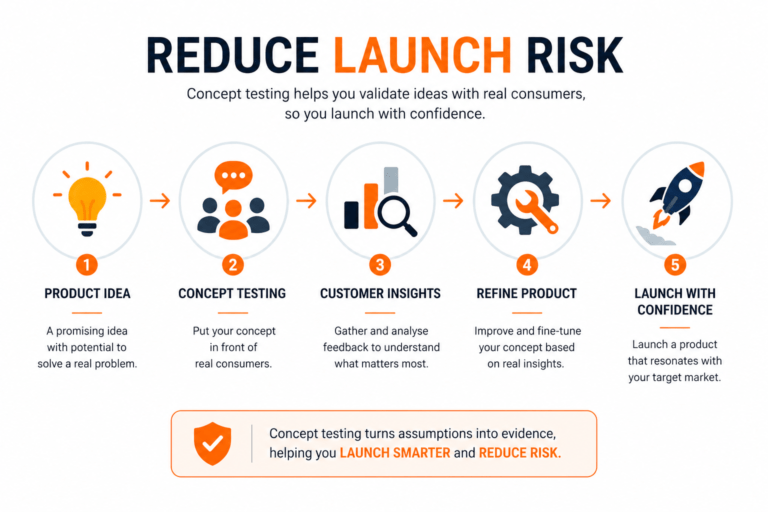
This is exactly the gap concept testing is built to close. Before a single unit is manufactured or a campaign goes live, concept testing puts the raw idea in front of real consumers and asks a simple question: does this actually matter to you? The answer, gathered systematically, is what separates a calculated launch from a hopeful one.
The Real Cost of Skipping Validation
The statistics around new product failure vary depending on who’s measuring and how “failure” is defined, but they consistently point in the same direction: launching without validation is a high-risk activity. Clayton Christensen of Harvard Business School has been widely cited for the observation that of the roughly 30,000 new products introduced each year, around 95 percent fail to succeed. Other researchers place the number lower but still steep — some studies on CPG products specifically point to failure rates of 70 to 85 percent within the first 18 months of launch.
It’s worth treating the highest-end figures with a healthy dose of skepticism. Some widely repeated “80 to 90 percent fail” claims are difficult to trace back to a single rigorous study, and the real number likely depends heavily on category, market, and how success is defined. But even the more conservative, better-sourced estimates are sobering enough to make the point: most new products don’t earn a lasting place in the market, and the reasons are rarely a mystery in hindsight.
Beyond the immediate cost of a failed launch — wasted production, marketing spend, and shelf space — there’s a slower, more corrosive cost. Failed launches can damage brand credibility, use up organizational goodwill for the next idea, and consume resources that could have funded a stronger concept instead. Delays compound the problem too: research from Gartner found that a large share of product launches slip by at least a month, often because the team didn’t fully understand what the market actually wanted before committing to a timeline.
Why Launches Actually Fail
It’s tempting to attribute failure to “bad products,” but the pattern researchers see again and again tells a different story. In CPG research specifically, the leading causes tend not to be product quality at all — they’re about misreading consumer needs, poor positioning, or insufficient differentiation from what’s already on the shelf.
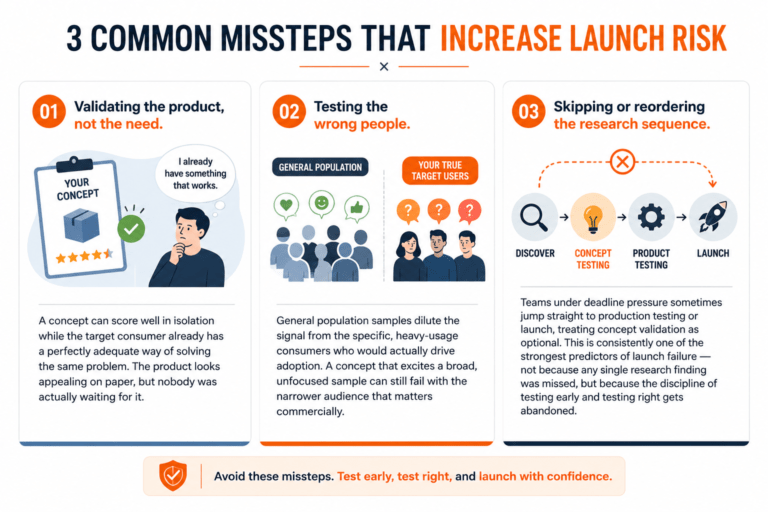
Three recurring mistakes show up across categories:
What Concept Testing Actually Is
Concept testing is a market research method used to gauge how consumers respond to a product, service, or campaign idea before it’s fully built or launched. It sits earlier in the development timeline than product testing, which evaluates something that already exists as a prototype or finished item. Concept testing works with descriptions, sketches, mockups, or simple renderings — the idea in its rawest, cheapest-to-change form.
That timing is the whole point. At the concept stage, changing direction costs a fraction of what it costs after tooling, packaging, and production commitments are locked in. Concept testing is designed to surface whether an idea genuinely resonates, whether it answers a real unmet need, and where it needs to be sharpened — while all of that is still inexpensive to act on.
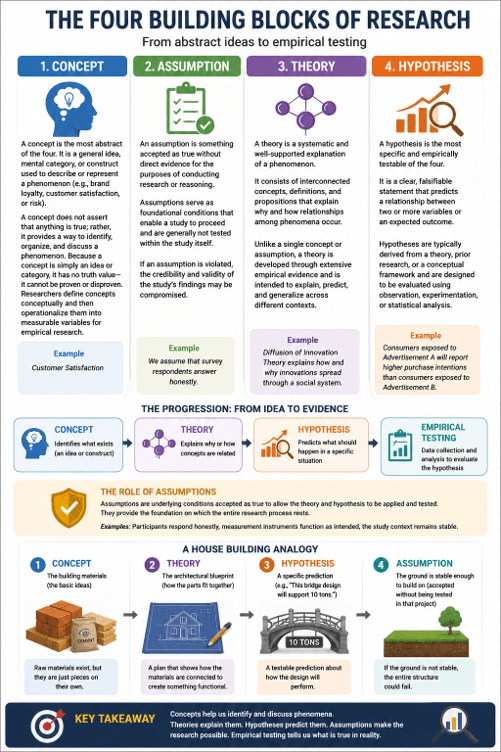
A quick note on terminology: in academic and research methodology, “concept” usually refers to an abstract idea used to describe a phenomenon (like “brand loyalty” or “risk”), distinct from a theory (a broader explanatory framework), an assumption (an unproven premise taken as a starting point), or a hypothesis (a specific, testable prediction). In product development, “concept” is used more narrowly — it simply means the proposed product, service, or campaign idea itself, described in enough detail for consumers to react to it. That’s the sense used throughout this article, and it’s worth keeping the distinction in mind if you’re drawing on academic research methodology alongside applied market research.
How Concept Testing Reduces Risk
The mechanism is straightforward: concept testing replaces internal conviction with external evidence, at the point in the process where evidence is cheapest to gather and act on. In practical terms, it delivers a few concrete benefits:
- It catches expensive problems early. Understanding what resonates — and what doesn’t — before committing to development budgets means changes happen on paper, not on the production line.
- It gives stakeholders and investors something firmer than opinion. A concept backed by consumer evidence is a much easier case to make internally than a concept backed only by conviction.
- It compresses the path to market. Instead of a slow trial-and-error cycle after launch, teams can make targeted refinements before launch, based on what the data actually shows.
- It builds a base of early loyalty. Products shaped by real consumer input tend to launch into a market that’s already primed to want them, rather than one that has to be convinced from scratch.
Companies that build rigorous testing into their development process — rather than treating it as a final rubber stamp — report meaningfully lower failure rates as a result, with some estimates in the range of 30 to 50 percent reduction. That’s not a guarantee, but it’s a substantial shift in the odds.
Choosing the Right Testing Method
For research teams and agencies, concept testing isn’t a single technique — it’s a family of methods, and choosing the right one shapes the quality of the answer you get.
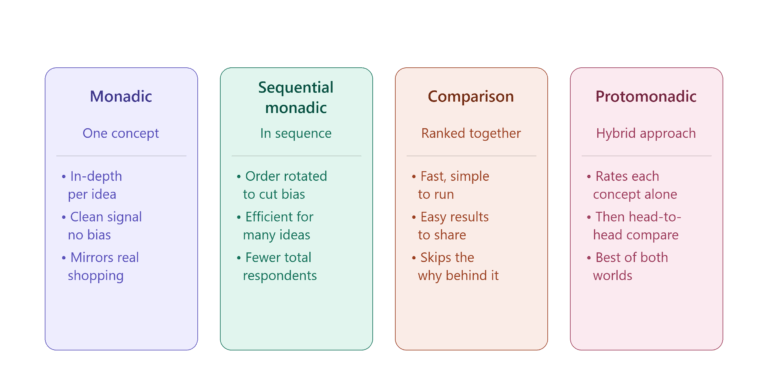
Monadic testing shows each respondent a single concept, with no comparison to alternatives. Because attention isn’t split, this method allows for more in-depth questioning and produces clean, uncontaminated feedback on that one idea. It also mirrors real life reasonably well, since consumers usually encounter a product on its own rather than lined up against competitors.
Sequential monadic testing shows the same respondents several concepts, one after another, evaluating each before moving to the next. To prevent the order in which concepts are shown from skewing results — a distortion known as order bias — researchers typically split respondents into groups and rotate the sequence. This method is more efficient when there are several concepts to test and budgets or timelines are tight, since it needs fewer total respondents than running separate monadic groups for each concept.
Comparison (or forced-choice) testing puts multiple concepts side by side and asks respondents to rank or pick a favorite. It’s fast, simple to run, and produces easy-to-communicate results — but it doesn’t dig into why respondents preferred one option, which limits how actionable the output is on its own.
Protomonadic testing combines the two: a monadic evaluation of each concept individually, followed by a paired or forced-choice comparison at the end. This hybrid gives strong diagnostic detail per concept while still producing a clear head-to-head read.
There’s no universally “best” method — the right choice depends on how many concepts need testing, the budget available, and whether the priority is depth of insight or speed of decision-making.
There’s no universally “best” method — the right choice depends on how many concepts need testing, the budget available, and whether the priority is depth of insight or speed of decision-making.
Concept Testing vs. MVP: Where They Fit Together
Concept testing is often mentioned in the same breath as the Minimum Viable Product (MVP), and the two get conflated more often than they should. They sit at different stages of development and answer different questions — understanding the distinction helps teams know which tool to reach for, and when.
Concept testing happens before anything is built. It evaluates a description, mockup, or value proposition against consumer reactions, asking whether the idea resonates before any real development resources are committed. An MVP comes after a concept has already been judged worth pursuing — it’s the smallest functional version of the actual product, built to observe real behavior rather than stated opinion. Does someone actually use it, pay for it, or come back to it?
That distinction — stated preference versus revealed preference — is the crux of it. Concept testing captures what people say they would do. An MVP captures what they actually do once the product exists and using it carries a real cost, whether that’s time, money, or effort. The two frequently diverge: a concept can score well in a survey and still see a built product go unused, which is exactly the gap an MVP is designed to catch.
In practice, the two methods work best as a sequence rather than a substitute for one another:
- Generate several concepts
- Concept-test them to narrow down to the strongest one or two ideas — fast, inexpensive, and effective at eliminating weak options early
- Build an MVP of the concept(s) that survive testing
- Observe real usage and behavioral data from the MVP
- Iterate on the product or make the go/no-go launch call
Concept testing functions as the earlier, cheaper filter — narrowing the field before any development budget is spent building something people may never use. The MVP is the more expensive, higher-fidelity checkpoint that follows.
One caveat worth noting for physical and CPG products: a true MVP in the software sense — a stripped-down, iteratively improved build — often isn’t practical when the product is a bar of soap or a packaged snack. In these categories, concept testing tends to carry more of the validation weight on its own, sometimes paired with a limited market test, such as a soft launch in a single region or retailer, which functions as the closest physical-product equivalent to an MVP.
A Necessary Word of Caution
Concept testing is a risk-reduction tool, not a crystal ball, and it’s worth being honest about that with clients. There’s a long-running debate within the research industry about over-correcting for false positives — killing concepts in testing that might actually have succeeded in market, out of an abundance of caution. Good concept testing isn’t about reaching zero risk; it’s about being a better predictor of outcomes than gut instinct alone, while staying alert to the fact that testing methodology itself can introduce its own blind spots.
This is also why sample quality matters more than sample size. A well-targeted group of 150 relevant category buyers will generally tell you more than 1,000 respondents drawn from the general population.
Concept Testing in the Malaysian and Southeast Asian Context
For brands and agencies operating in Malaysia, a few local considerations shape how concept testing should be run:
- Multi-ethnic segmentation matters. Malaysia’s consumer base spans distinct cultural and language groups, and a concept that resonates with one segment may land very differently with another. Testing should account for this rather than treating “Malaysian consumers” as a single homogenous group.
- Language of the concept board matters. Presenting the same concept in Bahasa Malaysia, English, and Mandarin can surface meaningfully different reactions, particularly for messaging-driven concepts like FMCG packaging or campaign taglines.
- Halal and religious considerations often need to be tested explicitly, not assumed, particularly for food, beverage, and personal care concepts.
- Online panels have become the dominant delivery method across the region, offering faster fieldwork and lower costs than traditional face-to-face methods, though they require careful panel quality checks to avoid the “wrong respondent” problem described earlier.
Key Takeaways
- Most new product launches fail, and the leading causes are usually about misunderstood needs and positioning, not product quality.
- Concept testing works because it operates at the cheapest possible point to make changes — before development and production costs are locked in.
- The method you choose (monadic, sequential monadic, comparison, or protomonadic) should match your number of concepts, budget, and need for depth versus speed.
- Testing quality depends more on reaching the right respondents than on reaching a large number of them.
- In the Malaysian market, language, ethnic segmentation, and religious considerations should be built into the testing design from the start, not treated as an afterthought.
Concept testing won’t guarantee a hit. But it consistently shifts the odds in a launch’s favor — replacing hope with evidence, at the one stage of development where evidence is still cheap to act on.
Metrix Research is a Malaysia-based market research consultancy helping brands and businesses make better decisions through robust consumer insights and evidence-based research. Discover how we can help you measure and maximise your research impact by exploring our website or contact us today.
Sources referenced: Harvard Business School (via secondary reporting), Gartner, Nielsen (via secondary analysis), and industry research from Alchemic, Market Logic, User Intuition, Clusters Insights & Analytics, NewMR, Contentsquare, aytm, QuestionPro, and SurveyMonkey. Some widely circulated failure-rate statistics are attributed across multiple secondary sources without a single traceable primary study; these are presented above as commonly cited industry figures rather than precise academic findings.