

How Mystery Shopping Uncovers Service Problems — And What Malaysian Businesses Should Do About It
A structured guide for FMCG brands, retailers, and service businesses operating in Malaysia
Your frontline staff have been trained. Your SOP is documented. Your outlet looks the part. But do your customers actually experience the service you think you are delivering?
This is the question that mystery shopping is designed to answer, and for Malaysian businesses operating across multiple locations, competitive retail environments, and a multicultural shopper base, the gap between intended and delivered service is often wider than management expects.
In this article, we explain what mystery shopping is, how it works as a diagnostic research tool, the specific types of service problems it surfaces, and why it delivers measurable business results. We also look at what this means for businesses in Malaysia’s FMCG, retail, F&B, and service sectors.

What Is Mystery Shopping?
Mystery shopping is a structured customer experience research methodology where trained evaluators pose as ordinary customers to assess a business’s service quality, operational compliance, and end-to-end customer experience.
Unlike sentiment-driven tools such as customer satisfaction surveys or Net Promoter Score (NPS), mystery shopping generates observational data. The shopper does not just tell you how they felt — they record exactly what happened, when, and how.
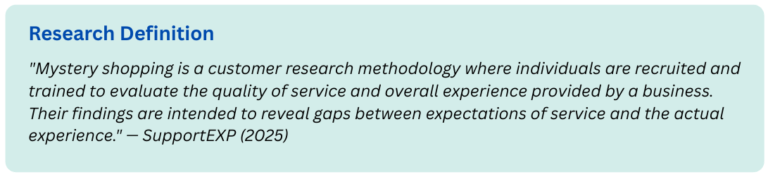
The methodology has its roots in US retail in the 1940s, where covert evaluators were used primarily to detect employee theft and misconduct. By the 1980s and 1990s, as service quality research came into its own, mystery shopping evolved into a fully-fledged research tool grounded in academic theory.
Today, it is one of the most widely used tools in customer experience measurement — and its global market reflects this. The mystery shopping industry was valued at USD 2.22 billion in 2024 and is projected to reach USD 3.24 billion by 2032.
Why Mystery Shopping Reveals What Other Methods Cannot
Most service quality measurement tools, surveys, online reviews, complaint systems — are reactive. They capture the customer’s perception after an experience has concluded. Mystery shopping is different in a fundamental way.

This proactive dimension is particularly valuable for businesses with multiple service touchpoints or branches. By the time a customer complaint surfaces, the damage to satisfaction, to loyalty, to reputation has already occurred. Mystery shopping identifies the problem upstream, when it can still be corrected.
Furthermore, it captures behaviour that frontline employees only exhibit when they believe no one is watching. When staff know they are being evaluated, they adjust their conduct. Mystery shopping removes that effect entirely, producing a more accurate picture of everyday service reality.
There are essentially three key dimensions of evaluation:
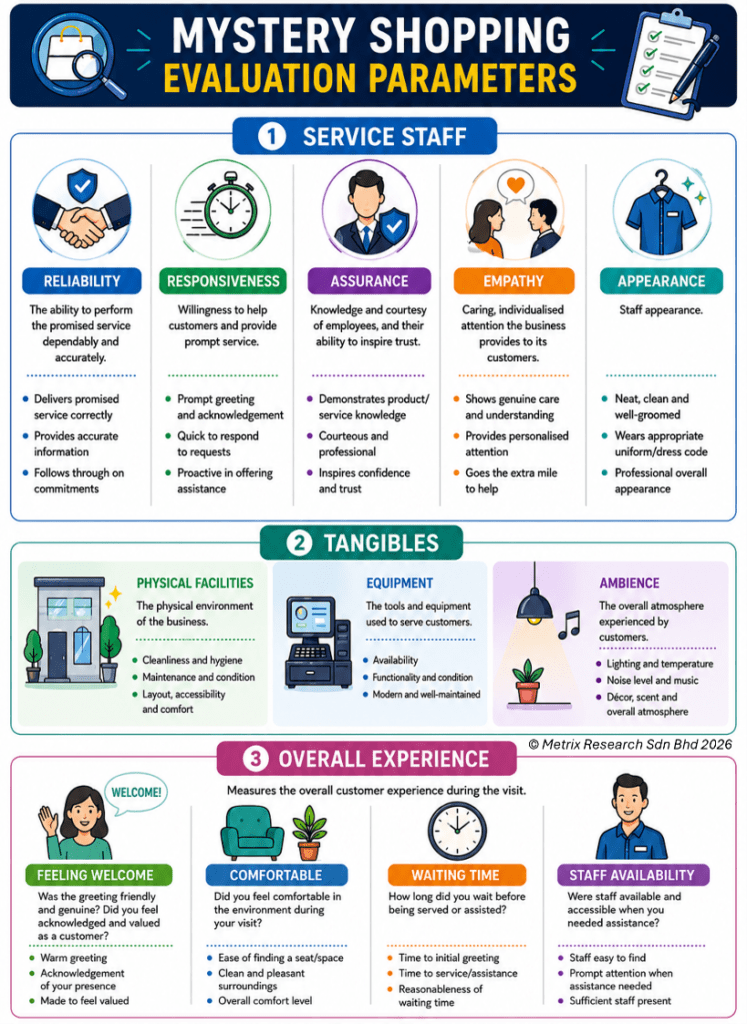
Outcome: Measure both the human interaction experience and the physical environment experience to provide a comprehensive view of customer service quality.
What Service Problems Does Mystery Shopping Uncover?
A well-designed mystery shopping programme covers every node of the customer journey. The types of service problems it consistently surfaces can be organised into five broad categories.
No | Category | Details |
1 | Staff Behaviour and Service Delivery Gaps | This is the most commonly assessed mystery shopping category. Shoppers evaluate whether frontline employees greet customers appropriately, demonstrate product knowledge, provide relevant recommendations, handle complaints professionally, and adhere to brand communication standards. Retail studies consistently identify inadequate staff training, weak product knowledge, and missed upselling opportunities as common service issues. Addressing these gaps has been shown to improve both customer satisfaction and sales performance. In Malaysia’s multilingual retail environment, where customer interactions frequently occur in Bahasa Malaysia, English, and Mandarin. Staff behaviour evaluations are especially important for ensuring consistent, high-quality service across diverse customer groups. |
2 | Compliance Gaps Between Policy and Practice | Many businesses have well-documented SOPs. Mystery shopping reveals whether those SOPs are actually being followed on the ground. SafetyCulture (2026) notes that mystery shoppers evaluate whether employees are following company policies and operational procedures. By identifying compliance gaps, retailers can ensure consistent service delivery and protect their brand reputation. This is especially critical for multi-branch operations, a common structure in Malaysian FMCG retail and F&B. Service quality inconsistency across outlets is one of the most damaging and hardest-to-detect problems for growing brands. |
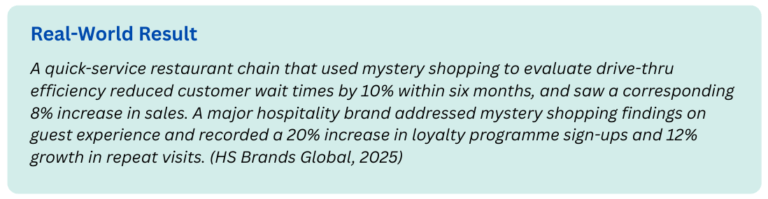
3 | Process and Operational Inefficiencies | Beyond staff behaviour, mystery shopping evaluates the operational environment: wait times, queue management, store cleanliness, shelf organisation, pricing accuracy, product availability, and the ease of the checkout or payment process. A practical example: drive-thru mystery shopping research found that when speaker clarity was good, wait times were 54 seconds faster on average, and when customers did not need to repeat their order, a further 1 minute and 25 seconds was saved, directly impacting throughput and customer satisfaction (InTouchInsight, 2025). |
4 | Information Accuracy and Transparency Failures | Mystery shopping is particularly effective at detecting whether customers are receiving accurate, complete, and consistent information. This is a significant issue in sectors such as financial services, healthcare, and telecommunications, where misinformation can create compliance risk as well as customer dissatisfaction. Academic research has found that mystery shopping can uncover multiple forms of transparency failure, including gaps in process transparency, product/service scope transparency, and cross-channel consistency (ResearchGate, 2001). In regulated industries, these findings have direct compliance implications. |
5 | Blind Spots That Internal Monitoring Misses | Perhaps the most strategically valuable contribution of mystery shopping is that it catches what internal monitoring cannot. Management walkthroughs, CCTV, and internal audits all carry an observer effect, behaviour changes when staff know they are being watched. Mystery shopping removes this effect. CGAP’s assessment of the method concludes that no other market monitoring tool so directly and proactively uncovers how businesses respond to real customer situations, including those involving specific customer profiles, edge-case requests, or complaint scenarios (CGAP, 2023). |
The Business Case: Mystery Shopping and ROI
Mystery shopping is an investment, and like any research investment, it must justify itself commercially. The evidence base here is strong.
Key Business Impact Statistics:
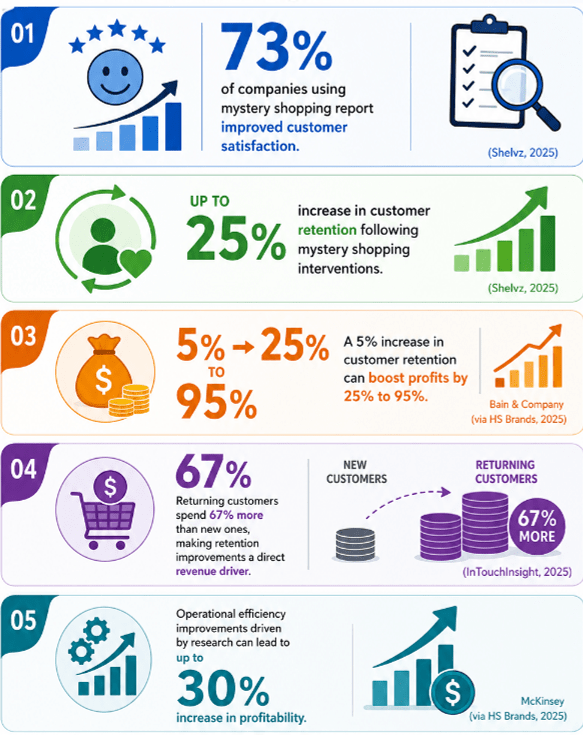
The ROI calculation becomes clearer when mystery shopping findings are tracked against business KPIs. Intouch Insight (2025) recommends correlating mystery shopping data with customer retention rates, average transaction value, repeat customer rate, revenue by location, employee performance metrics, and Net Promoter Scores — giving brands a comprehensive, quantified picture of impact.
How to Turn Mystery Shopping Findings Into Action
Mystery shopping data is only valuable when it drives change. The most effective programmes follow a structured cycle: evaluate, identify, act, and re-evaluate.
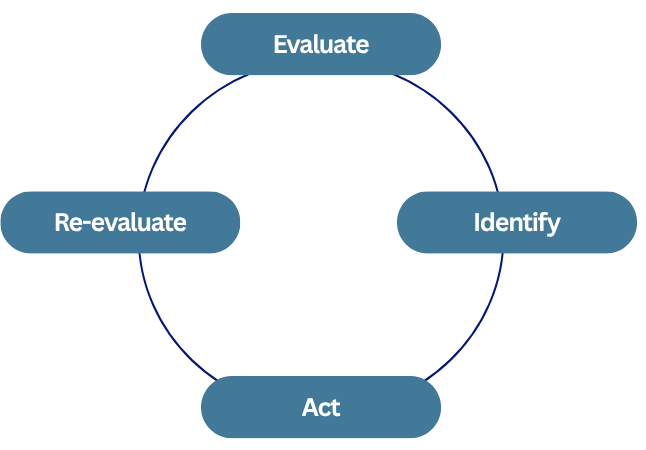
- Study customer interaction patterns across branches and time periods to identify recurring, systemic issues, not isolated incidents
- Benchmark performance against your own brand standards and, where possible, against industry norms
- Integrate findings with other data sources, i.e. customer satisfaction surveys, NPS results, complaints data, and social media sentiment, for a comprehensive view
- Use findings to inform targeted staff training, not generalised retraining programmes
- Set measurable improvement targets and schedule follow-up mystery shopping visits to track progress
One important implementation consideration: research shows that employee acceptance of the mystery shopping process is critical to its effectiveness. When staff perceive the programme as punitive surveillance rather than a development tool, their willingness to act on the results declines, and the method defeats its purpose.
Transparent communication about the programme’s objectives helps build this acceptance.
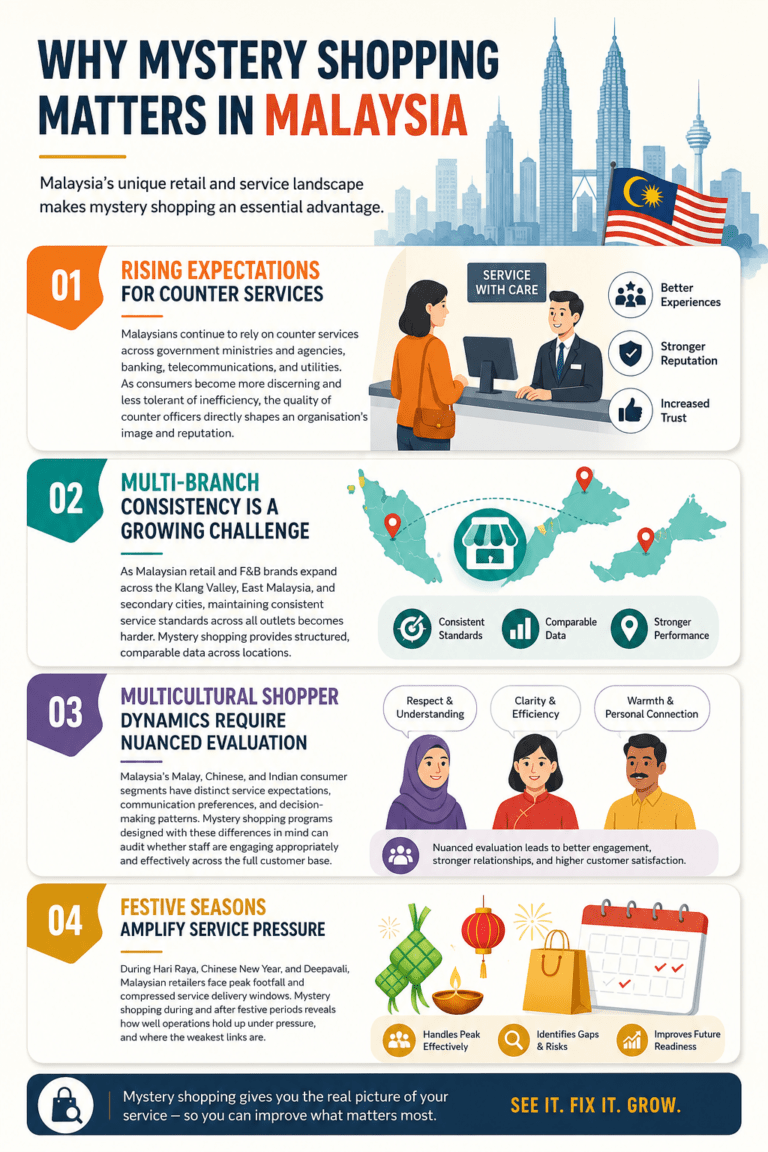
Mystery Shopping in the Malaysian Context
Conclusion
Service problems rarely announce themselves. They accumulate quietly, in the gap between what your SOP says and what your staff actually do, between what management observes and what customers genuinely experience.
Mystery shopping closes that gap. By deploying trained evaluators who observe your business exactly as a real customer would, you surface the specific behaviours, process breakdowns, and compliance failures that are silently eroding satisfaction, loyalty, and revenue.
For Malaysian businesses, whether you operate a retail chain, an FMCG brand, a restaurant group, or a service business, mystery shopping is one of the highest-value research tools available.
It tells you not what customers say about your service, but what your service actually is. That distinction is the foundation of meaningful improvement.
Need to know if your business should invest in Mystery Shopping?
We curated this FREE 3-minutes simple quiz for you to take and find out how your business can benefits from Mystery Shopping
Metrix Research is a Malaysia-based market research consultancy helping brands and businesses make better decisions through robust consumer insights and evidence-based research. Discover how we can help you measure and maximise your research impact by exploring our website or contact us today.
For more articles, please explore insights
References
- Bain & Company (cited via HS Brands Global, 2025). The ROI of Mystery Shopping: Data and Success Stories. hsbrands.com
- CGAP / World Bank (2023). Tool 5: Mystery Shopping. Market Monitoring Tool series. cgap.org
- Greenbook (2024). How to Use Mystery Shopping Research to Improve the Customer Experience. greenbook.org
- InTouchInsight (2025). How to Measure the ROI of Your Mystery Shopping Program. intouchinsight.com
- Ipsos (2023). Using Mystery Shopping to Proactively Measure Staff Engagement with Consumer Duty. ipsos.com
- LearningLoop / Product Experiment (2025). Mystery Shopper — What It Is, How It Works, Examples. learningloop.io
- Market Xcel (2025). Mystery Shopping Research: How Brands Can Improve Customer Experience. market-xcel.com
- McKinsey & Company (cited via HS Brands Global, 2025). Operational Efficiency and Profitability.
- Parasuraman, A., Zeithaml, V.A., & Berry, L.L. (1988). SERVQUAL: A Multiple-Item Scale for Measuring Consumer Perceptions of Service Quality. Journal of Retailing, 64(1), 12–40.
- ResearchGate / Wilson, A.M. (2001). Mystery Shopping: Using Deception to Measure Service Performance. researchgate.net
- SafetyCulture (2026). Retail Mystery Shopping: Techniques & Process. safetyculture.com
- Shelvz (2025). Superior Customer Experience Through a Mystery Shopping Solution. shelvz.com
- SI Labs (2026). Mystery Shopping: Definition, Process & Practical Guide. si-labs.com
- Statista (2024). FMCG Market in Malaysia — Statistics & Facts. statista.com
- SupportEXP (2025). Mystery Shopping vs. Market Research: What Are the Differences and Similarities? supportexp.com