

Identifying Underserved Niche Markets
A practical guide for Malaysian retail and consumer goods brands, including SMEs
Most retail and consumer goods categories in Malaysia feel crowded. Browse any shopping mall, marketplace or food delivery app and you will find dozens of near-identical options, whether the product is a nasi lemak set, a bubble tea or a baju kurung. Yet even crowded markets contain pockets of customers whose needs are poorly met. Finding those pockets, known as underserved niche markets, is one of the most practical growth strategies for marketers and strategists, especially in SMEs that cannot outspend larger rivals.

This article explains what an underserved niche is, why the approach suits Malaysian businesses, how to find one by combining secondary data with primary research, where opportunities appear to be emerging in F&B and fashion, and which pitfalls to avoid.

1. What is an underserved niche market?
In Kotler’s framing, a niche is a more narrowly defined customer group, typically a small market whose needs are not being well served. Marketers usually identify niches by dividing a segment into sub-segments, or by defining a group that seeks a distinctive mix of benefits (Kotler, 2003, as cited in MBA Knowledge Base, n.d.).
Not every small segment is a good niche. Kotler’s often-quoted test of an attractive niche has five parts (Kotler, 2003, as cited in Segmentation Study Guide, n.d.). They work well as a screening checklist before you invest in a new product line or campaign:
Criterion | Question to ask | Evidence to look for |
Distinct needs | Do these customers describe problems that mainstream offers do not solve? | Workarounds, complaints, requests for “something like X but…” |
Willingness to pay a premium | Will they pay more for a closer fit? | Premium tiers that sell, price-test results |
Limited competitive attention | Are larger players ignoring or poorly serving this group? | Few specialised offers, thin shelf presence |
Gains from specialisation | Can you build expertise or capability others cannot easily copy? | Product know-how, community trust, supply access |
Size, profit and growth potential | Is it large enough to be profitable, and growing? | Sized demand, trend data, repeat-purchase behaviour |
2. Why niche strategy suits Malaysian SMEs
Malaysia’s business landscape is dominated by small firms. According to SME Corp Malaysia, citing DOSM data, micro, small and medium enterprises (MSMEs) made up 96.1% of all business establishments in 2024, and microenterprises alone accounted for 70.1% of MSMEs (SME Corp Malaysia, n.d.). DOSM’s latest release shows MSME GDP grew 5.7% in 2025 to RM689.8 billion, or 39.7% of national GDP (DOSM, 2026).
For businesses of this size, competing head-on with national chains or large marketplace sellers is rarely realistic. Niche marketing lets businesses focus limited resources. Niche marketers tend to be small to medium-sized organisations, and successful ones gain reduced competition, strong customer loyalty, and the ability to charge premium prices. The trade-off is that reliance on a small market is risky (Segmentation Study Guide, n.d.).
3. Start with the job, not the demographic
Traditional segmentation starts with who the customer is: age, income, location.
A more productive way to find underserved needs is to start with what the customer is trying to get done, or JOB-TO-BE-DONE. Christensen and colleagues argue that you cannot simply ask customers what job they are trying to do, because most do not know what they are trying to achieve or how to explain it (Christensen et al., 2016).
Two ideas from this “jobs to be done” approach are especially useful for niche discovery:
- Look for non-consumption. The best and often hardest opportunities lie where your solution competes against no others. Understanding the non-consumption space can reveal jobs that nobody is currently addressing (Christensen et al., 2016, as summarised by Purdue Center for Food and Agricultural Business, n.d.).
- Widen your definition of competition. The real competitors are everything that could get the same job done, which is usually wider than your product category. A kopitiam, a cloud-kitchen brand and a convenience-store ready meal may all be competing for the same “quick, filling lunch” job.
In research terms, this points towards in-depth interviews, shop-alongs and observation rather than surveys alone.
Qualitative work uncovers the jobs and workarounds, and quantitative work then sizes them.
4. Where underserved niches may be emerging
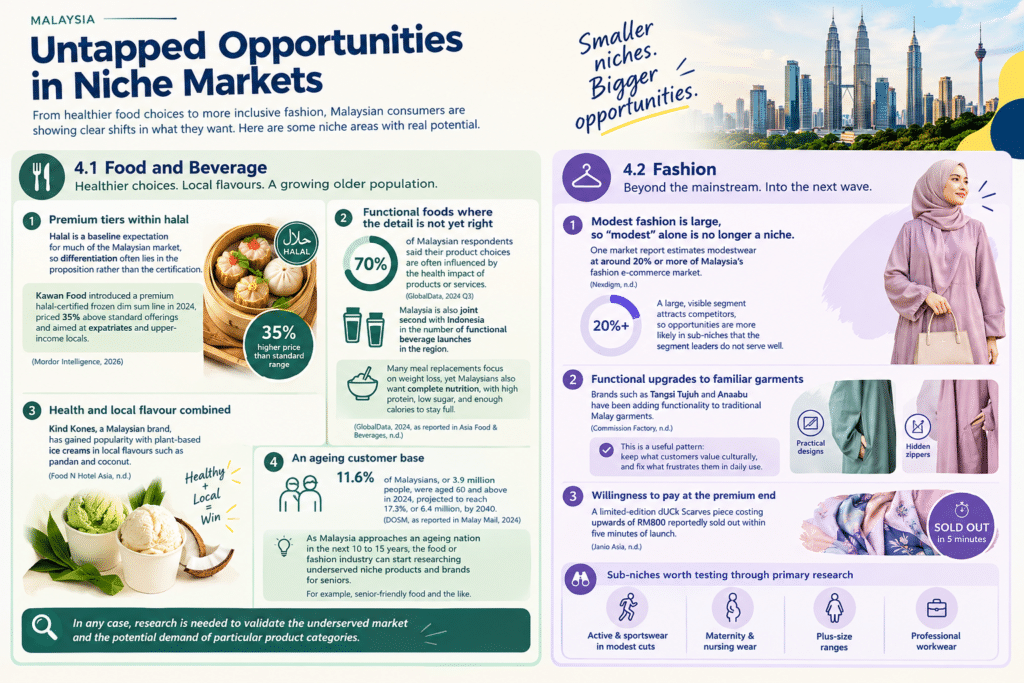
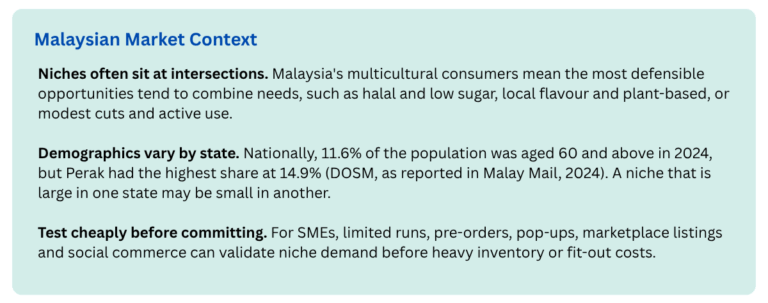
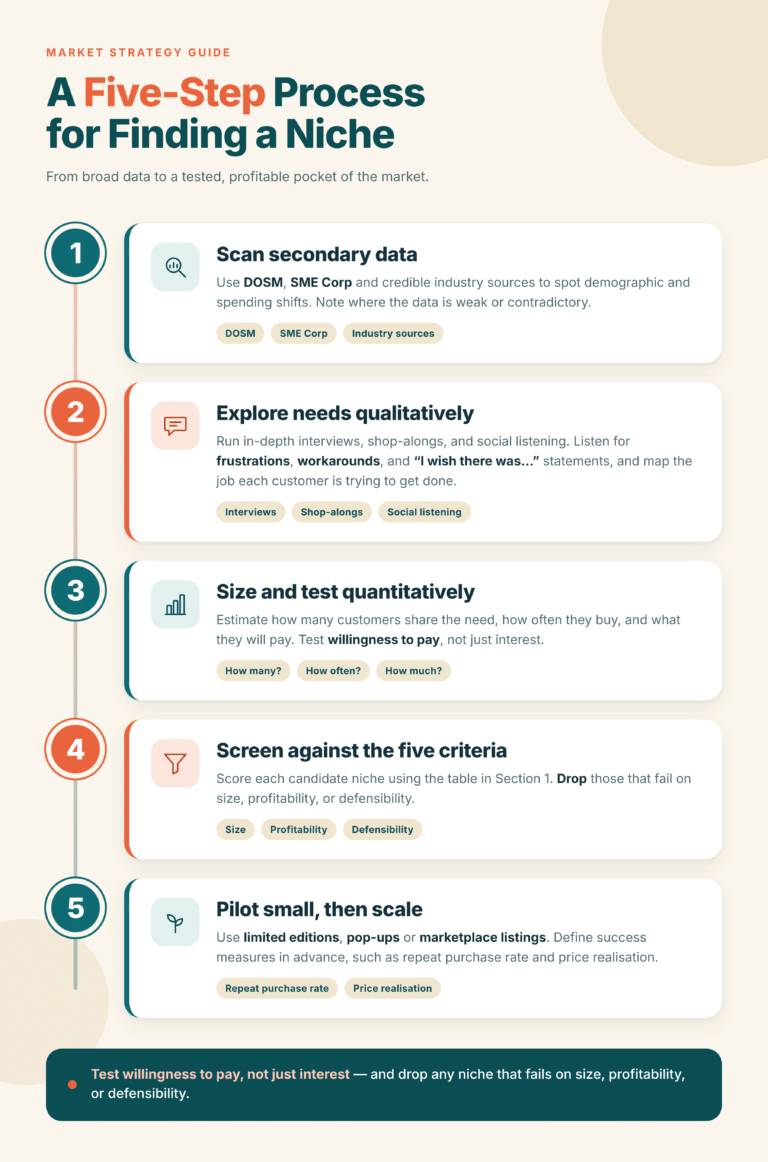
5. A five-step process for finding a niche
6. Common pitfalls
- Over-niching. A segment that is too small cannot sustain a business. Reliance on a small market is the key risk of niche strategies (Segmentation Study Guide, n.d.).
- Mistaking a trend for a niche. Rising interest does not prove an underserved, paying segment. Look for unmet needs plus evidence of spend.
- Relying on inconsistent market-size figures. Halal market estimates illustrate the problem. One report puts the Malaysia halal food market at USD 50.66 billion in 2024 (Blueweave Consulting, n.d.), while another estimates the Malaysia halal foods market at USD 36.55 billion in 2025 (Industry Research Biz, n.d.). The scope, year, and method differ, so figures are not directly comparable.
Triangulate secondary estimates and ground sizing in primary research.
- Ignoring the competition from adjacent solutions. If customers already solve the job another way, your niche is not truly unserved.
7. What this means for marketers and strategists
- Treat niche identification as a research project, not a brainstorm. Combine desk research, qualitative discovery, and quantitative sizing.
- Define the niche by the job and need, not only by age, income or ethnicity.
- Screen every candidate against the five criteria before investing.
- Plan small pilots and agree success metrics before launch.
- Re-check your niche regularly. Demographics, regulation, and competitors all change.
Frequently asked questions
What is an underserved niche market?
It is a narrowly defined customer group, usually small, whose needs are not being well served by existing offers, and who may be willing to pay a premium for a better fit.
How can a Malaysian SME find an underserved niche?
Combine secondary data such as DOSM statistics, qualitative research into customer jobs and frustrations, and quantitative sizing. Then screen candidates against size, profitability, competition, and defensibility, and pilot before scaling.
How big does a niche need to be?
It must be large enough to be profitable and show growth potential, but small enough that it is not already a priority for larger competitors. Sizing it with research is the safest approach.
Conclusions
Underserved niches rarely announce themselves. They show up as workarounds, unmet expectations, and customers who quietly pay more for something that fits better. For Malaysian retail and consumer goods brands, particularly SMEs, the discipline lies in looking for the job the customer needs done, testing whether the niche is big and profitable enough, and learning through small pilots. Done well, niche focus turns limited resources into a defensible position.
If you are weighing a niche opportunity in F&B, fashion, or another consumer category, a well-designed mix of qualitative and quantitative research can help you size it and test it before you commit.
Metrix Research is a Malaysia-based market research consultancy helping brands and businesses make better decisions through robust consumer insights and evidence-based research. Discover how we help businesses understand consumer behaviour through qualitative and quantitative research by exploring our website or contact us today.
For more articles, please explore insights
References
Blueweave Consulting (n.d.) Malaysia Halal Food Market. Available at: https://www.blueweaveconsulting.com/report/malaysia-halal-food-market
Christensen, C.M., Hall, T., Dillon, K. and Duncan, D.S. (2016) ‘Know your customers’ “jobs to be done”‘, Harvard Business Review, September.
Commission Factory (n.d.) Ecommerce Fashion in Malaysia.
Department of Statistics Malaysia (DOSM) (2026) Malaysia’s Micro, Small and Medium Enterprises (MSMEs) Performance 2025, media statement, 30 July.
Food N Hotel Asia (n.d.) Why Asian Consumers Seek Healthier Food Options. A
GlobalData (2024) Q3 consumer survey, as reported in Asia Food & Beverages (n.d.) The Future of Functional: What’s Next for Malaysia’s Functional Food and Beverage Industry.
Industry Research Biz (n.d.) Halal Food and Beverage Market Size & Forecast.
Janio Asia (n.d.) 5 Malaysian Women’s Fashion eCommerce Market Trends.
Kotler, P. (2003) on niche marketing criteria, as cited in MBA Knowledge Base (n.d.) Introduction to Market Segmentation.
Malay Mail (2024) ‘DOSM: Malaysia to become aged nation by 2040 with population over 60 set to surge’, 6 September.
Mordor Intelligence (2026) Asia-Pacific Halal Food and Beverage Market
Nexdigm (n.d.) Malaysia Fashion E-Commerce Market Outlook to 2030.
SME Corporation Malaysia (n.d.) Profile of MSMEs 2015-2024.