

Is Cheaper Research Good Enough?
The Hidden Risk of Low-Cost Research

Every marketer and business owner has faced the same procurement dilemma:
Two research proposals land on the desk, one significantly cheaper than the other, and the temptation is to assume the outcome will be roughly the same.
It rarely is. The market research industry has a quiet, well-documented problem: when quality signals are unclear, buyers default to price as the easiest proxy for value, and that assumption is often the most expensive decision in the entire project.
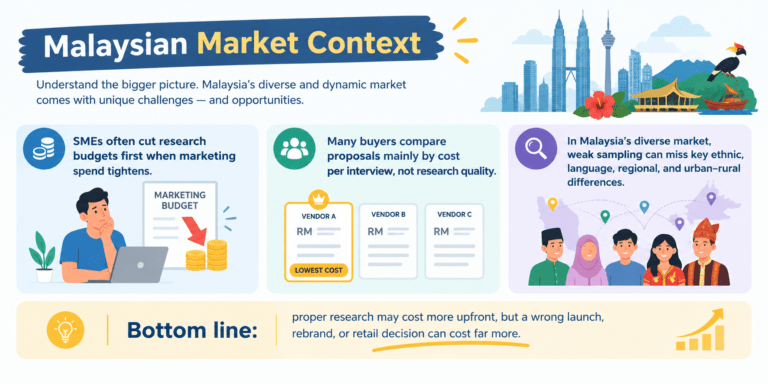
For marketers and strategists in Malaysia, particularly those in SMEs where every ringgit of the marketing budget is scrutinised, the pressure to choose the lower quote is real. But “low-cost” and “low-risk” are not the same thing.
This article unpacks where the corners actually get cut in cheap research, what it costs a business when those corners fail, and how to tell the difference between research that is efficiently priced and research that is dangerously underpriced.
The Cost-Quality Illusion
In the absence of clear, measurable quality indicators, research buyers tend to make procurement decisions on gut feeling rather than evidence, defaulting to the lowest cost-per-interview as though price were the most reliable signal of value.
The most intuitive driver of behaviour change is simply that people’s lives change. As consumers move through different life stages, their needs, budgets, and priorities shift.
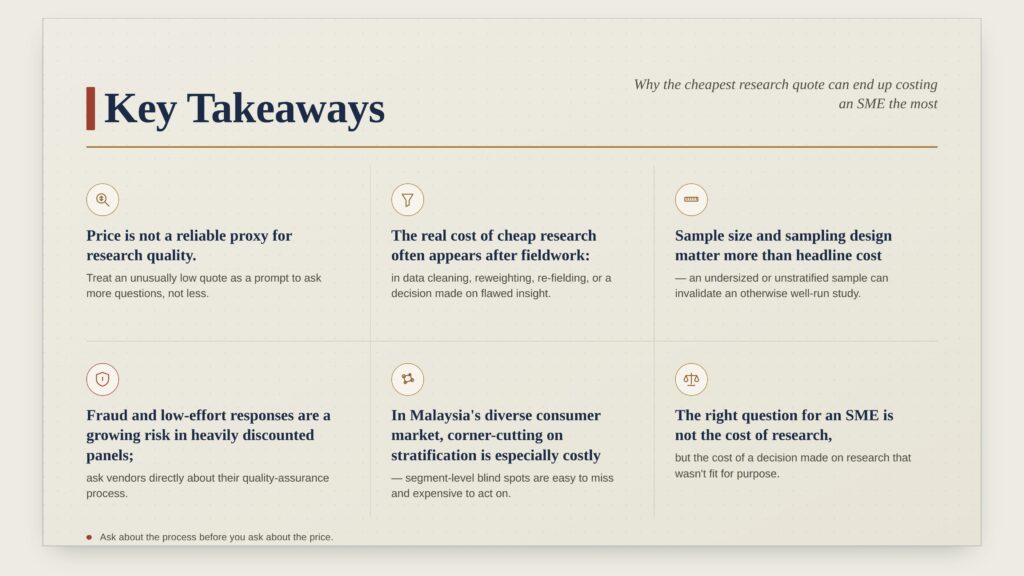
On a spreadsheet, this looks like a win. In practice, once the downstream costs of poor-quality data are counted – data cleaning that is time-consuming and never fully restorative, reweighting that merely signals something went wrong earlier in the process, and, in the worst cases, full re-fielding of the study. The economics shift dramatically, and the “cheap” option is frequently the more expensive one by the time a usable report is delivered.
There is a reputational dimension too. When a dataset requires significant post-processing before it can be trusted, clients and internal stakeholders trust the findings less, and that erosion of confidence outlasts the project itself, colouring how the next set of research findings is received by leadership.
Where the Corners Actually Get Cut
Low-cost research is not automatically bad research. A smaller, well-balanced sample can outperform a larger, biased one, and lean scopes are sometimes entirely appropriate. The risk is not the price tag itself, but what is typically sacrificed to hit it. Three areas are worth scrutinising in any quote that looks unusually low:
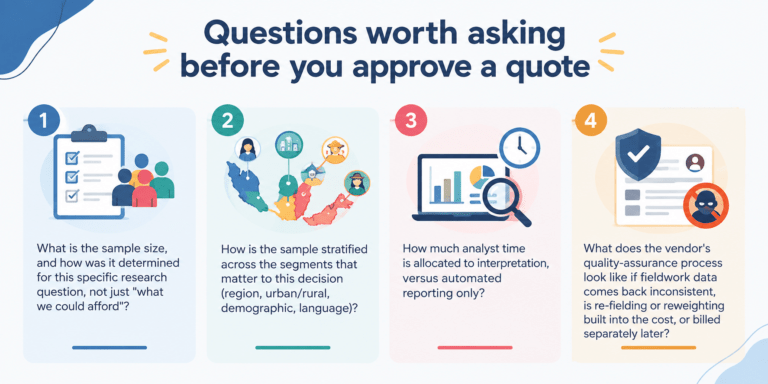
Insufficient sample sizes introduce a high degree of sampling error, which jeopardises the reliability of conclusions and increases the risk of erroneous interpretation. Academic reviewers have long flagged that studies built on samples of only 50–60 respondents cannot be relied upon, yet this is precisely the range that heavily discounted quotes often use to hit a price point. A cheap quote built on an undersized or poorly stratified sample is not a bargain — it is a coin flip.
Deep-discount online panels are more exposed to fraudulent respondents and bots, which are increasingly able to bypass quality checks.
For example, they may consistently select the shortest or longest option, or rank answers alphabetically, producing data that passes automated screening but offers no genuine insight. ESOMAR’s ESOMAR37 initiative promotes transparency in data quality, making it a practical benchmark for evaluating whether a low-cost sample provider is truly reliable.
Reduced fees often mean less time spent on questionnaire design, respondent screening, and analyst interpretation, steps that don’t show up as a line item but directly determine whether the findings actually answer the business question that was asked.
What It Costs When Cheap Research Goes Wrong
The consequences of acting on flawed research rarely stay contained to the research budget.
Poor data quality is a hidden disruptor that undermines otherwise well-planned strategies, distorting insights and leading to misguided decisions across marketing and business planning. In more concrete terms, organisations that rely on unreliable data:
- Risk releasing products for which there is no real demand,
- Launching campaigns that fail to resonate with the intended audience, or misattributing results to the wrong channel entirely. For example, crediting social media for brand awareness that was actually driven by out-of-home advertising.
The starkest illustration is new product performance.
Empirical studies indicate that roughly 30–40% of products that reach the market fail to meet their commercial objectives, and a study tracking nearly 9,000 new retail items found only about 40% were still on shelves three years after launch. In fast-moving consumer goods specifically, some estimates put failure rates as high as 70–85% within the first year or two. Inadequate market research is consistently identified as one of the leading causes.
Launching without a genuine understanding of the target market, customer needs, and competitive landscape tends to produce the wrong product features and the wrong go-to-market plan.
It is worth noting that the more dramatic “90–95% of products fail” figure circulating online is generally considered exaggerated and often conflates early-stage idea failure with the failure of products that actually launched — a distinction worth keeping in mind so the risk is understood accurately rather than sensationally.
How to Tell Lean from Risky: A Quick Evaluation Checklist
Not every low quote is a red flag, and not every premium quote guarantees quality. Before signing off on a research proposal, marketers and strategists should be able to get a straight answer to each of the following:
Key Takeaways
Metrix Research is a Malaysia-based market research consultancy helping brands and businesses make better decisions through robust consumer insights and evidence-based research. Discover how we can help you measure and maximise your research impact by exploring our website or contact us today.
For more articles, please explore insights
References
The Harris Poll. The Hidden Cost of “Cheap” Data. https://theharrispoll.com/articles/the-hidden-cost-of-cheap-data/
Kantar. Everything You Need to Know About Data Quality. https://www.kantar.com/inspiration/research-services/everything-you-need-to-know-about-data-quality-pf
Kantar. What Is Sample Size? https://www.kantar.com/inspiration/research-services/what-is-sample-size-pf
riwi. The Hidden Costs of Poor Data Quality in Market Research. https://riwi.com/news-media/hidden-costs-poor-data-quality/
Sharma, J.C. On the Methodological Issue of Sample Size. Gian Jyoti E-Journal, Vol. 3, Issue 4 (2013). https://www.gjimt.ac.in/wp-content/uploads/2017/10/8_J.C.-Sharma_On-the-Methodological-Issue-of-Sample-Size.pdf
Data Diggers Market Research. ESOMAR37 Guides & Playbooks. https://www.datadiggers-mr.com/resources/esomar37
LANPDT. Failure Rates of New Consumer Products: Statistics, Causes, and Ways to Improve Success. https://lanpdt.com/why-new-products-fail-how-success-is-measured
Drive Research. Reasons Why New Products Fail (& How to Avoid It). https://www.driveresearch.com/market-research-company-blog/why-products-fail/