

Why First Impressions Matter
The Psychology of the First Few Seconds in Retail and Counter Service
In retail and counter service, the outcome of a customer relationship is often decided long before the transaction itself begins.
A greeting, a glance, a moment of hesitation at the till – these fleeting cues do more to shape customer loyalty than most businesses realise. This article examines the psychological and service-quality research behind first impressions. It translates it into practical guidance for frontline retail and counter service teams operating in Malaysia’s competitive consumer market.
The Psychology Behind First Impressions
Human beings form judgements about other people remarkably fast, and those judgements tend to stick.
This phenomenon, known in psychology as “thin-slicing,” was established through a landmark meta-analysis by Nalini Ambady and Robert Rosenthal, who found that observers could make surprisingly accurate assessments of a person’s traits and intentions based on just a few seconds of behaviour, sometimes even less than that (Ambady & Rosenthal, 1992).

Subsequent studies have shown that judgements formed within the first moments of an interaction strongly anchor everything that follows, making later information less influential unless it sharply contradicts that initial impression.
For a retail cashier, a pharmacy counter assistant, or a bank teller, this has a direct and sobering implication: the customer has often already formed a judgement about the quality of service they are about to receive before a single word of the actual transaction is spoken.
Facial expression, posture, tone of the greeting, and the speed of acknowledgement all become data points a customer subconsciously uses to predict how the rest of the encounter will go.
Every Counter Interaction Is a “Moment of Truth”
The idea that individual customer contacts can make or break a company’s reputation was popularised by Jan Carlzon, the former CEO of Scandinavian Airlines, in his influential book Moments of Truth.
Carlzon observed that each of the airline’s ten million annual customers came into contact with an average of five employees, with each contact lasting around 15 seconds, amounting to 50 million “moments of truth” a year in which the brand was either reinforced or undermined (Carlzon, 1987).
His response was to push decision-making authority down to frontline staff, on the basis that they, not head office, were the ones actually holding the company’s reputation in their hands at any given moment.
The same logic applies directly to retail counters and service points. A customer’s total relationship with a brand may consist of nothing more than a handful of short transactions each month. When each of those transactions is brief, the quality of that one moment carries disproportionate weight in shaping how the customer perceives the business as a whole.

What Customers Actually Judge: The SERVQUAL Tangibles Dimension
Service quality research offers a more structured way to understand what customers are evaluating in those first seconds. The SERVQUAL model, developed by Parasuraman, Zeithaml, and Berry, identifies five dimensions customers use to judge service quality:
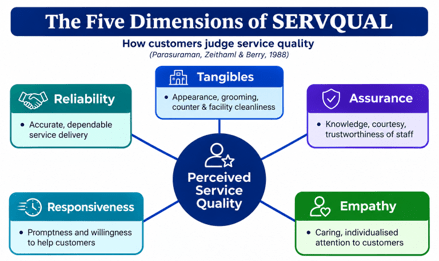
The tangibles dimension, covering staff appearance, grooming, uniform neatness, and the cleanliness of the service environment, is often the very first dimension a customer can assess, since it is visible before any conversation even begins.
This is particularly relevant for retail and counter service settings, where customers frequently cannot yet judge reliability or competence; they haven’t received the service yet, but can immediately judge tangibles. A tidy counter, a well-groomed and attentive staff member, and prompt eye contact all function as early proxies for the quality of service still to come.
Frontline Behaviour Drives Loyalty, Not Just Satisfaction
Beyond forming a single impression, frontline service quality has been shown to influence longer-term customer loyalty.
A study published in the Journal of Business Theory and Practice used structural equation modelling on customer data from retail outlets and found that responsiveness and assurance, both delivered directly by frontline staff, were the strongest contributors to perceived service quality, which in turn predicted customer satisfaction and loyalty (Journal of Business Theory and Practice, 2013).
In other words, the value of a strong first impression compounds. A customer who feels well received at first contact is more likely to interpret ambiguous moments later in the transaction charitably, more likely to return, and more likely to recommend the business to others, whereas a poor opening impression requires disproportionately more effort later in the interaction simply to bring the customer back to neutral.
Practical Implications for Retail and Counter Service Teams
Translating this research into day-to-day practice does not require a large budget; it requires deliberate attention to the moments that already happen dozens of times a day at every counter. The following are concrete, trainable actions for retail and counter service teams:
|
No |
Items |
Remarks |
|
1 |
Train for the first five seconds specifically |
Greeting speed, eye contact, and tone deserve as much attention in training as product knowledge or transaction accuracy. |
|
2 |
Treat grooming and counter presentation as a service quality metric |
This is not just a housekeeping matter. Tangibles are often the only dimension a customer can judge before the transaction starts |
|
3 |
Empower frontline staff to resolve small issues on the spot |
Echoing Carlzon’s principle that the people closest to the moment of truth need the authority to act in it. |
|
4 |
Localise soft-skill training to Malaysian consumer expectations |
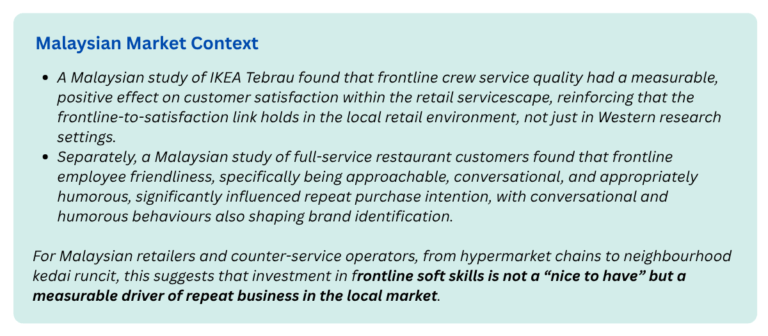
Drawing on evidence that approachable, conversational, and warm frontline behaviour measurably drives repeat purchase intention in the local market. |
|
5 |
Monitor first-contact quality separately from overall satisfaction scores |
Earliest moments of an interaction disproportionately anchor the customer’s overall judgement. |
Conclusion
The research is consistent across psychology, service management, and Malaysian-specific studies alike: first impressions in retail and counter service are not a soft, unmeasurable nicety; they are a well-documented driver of customer perception, satisfaction, and loyalty.
For businesses competing in Malaysia’s crowded retail and consumer services market, treating the first few seconds of every counter interaction as a strategic priority, rather than an afterthought, offers a clear and evidence-backed path to stronger customer relationships.
Metrix Research is a Malaysia-based market research consultancy helping brands and businesses make better decisions through robust consumer insights and evidence-based research. Discover how we can help you measure and maximise your research impact by exploring our website or contact us today.
For more articles, please explore insights
References
Ambady, N., & Rosenthal, R. (1992). Thin slices of expressive behavior as predictors of interpersonal consequences: A meta-analysis. Psychological Bulletin, 111(2), 256–274.
Carlzon, J. (1987). Moments of Truth. Cambridge, MA: Ballinger.
Parasuraman, A., Zeithaml, V. A., & Berry, L. L. (1988). SERVQUAL: A multiple-item scale for measuring consumer perceptions of service quality. Journal of Retailing, 64(1), 12–40.
Positive Service Encounter: A Tool for Customer Loyalty in Retail. (2013). Journal of Business Theory and Practice, 1(2).
Understanding Servicescape from the Perspective of Ethical Retail: A Study on Frontline Crew Service and Customer Satisfaction at IKEA Tebrau. Journal of Global Innovations, Universiti Malaysia Pahang.
Does frontline employee friendliness during service delivery still matter in the current era? Revisiting its dimensionality effects on brand outcome. (2025). Journal of Brand Management.