

Product and Customer Development: Twin Challenges
Why Malaysian businesses need evidence and AI-enhanced market research to win at both at once
Customers are the lifeline of any business. They are the primary source of revenue and the reason profit growth is possible at all. Management thinker Peter Drucker put it plainly: the purpose of a business is to create and keep a customer. Because that is its purpose, Drucker argued, a business really has only two functions that matter — marketing and innovation. Everything else is a cost.

Customer needs, however, are not static. Preferences shift, competitors close gaps, and what delighted a customer last year barely registers today. To keep satisfying customers, businesses must continually innovate their offerings, developing new products, refining existing ones, and finding new customers for both.
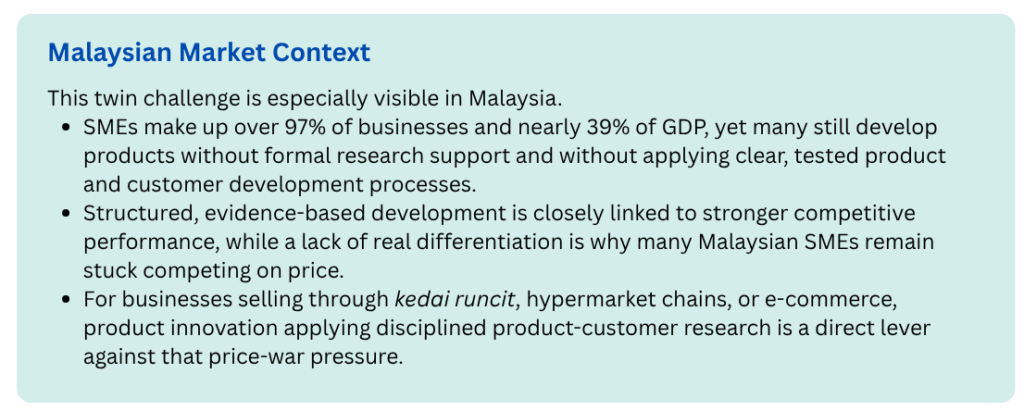
This is where the twin challenge emerges: product development and customer development. These two different disciplines must succeed together to achieve product-market fit. Get the product right but misread the customer, and the launch stalls. Understand the customer but build the wrong product, and the business still fails. Malaysian companies, from FMCG manufacturers to service-based SMEs, live with this dilemma regularly.
Key Issues
Before looking at solutions, it helps to identify what typically causes difficulties in achieving a product-market fit. Four difficulties recur across industries and company sizes.
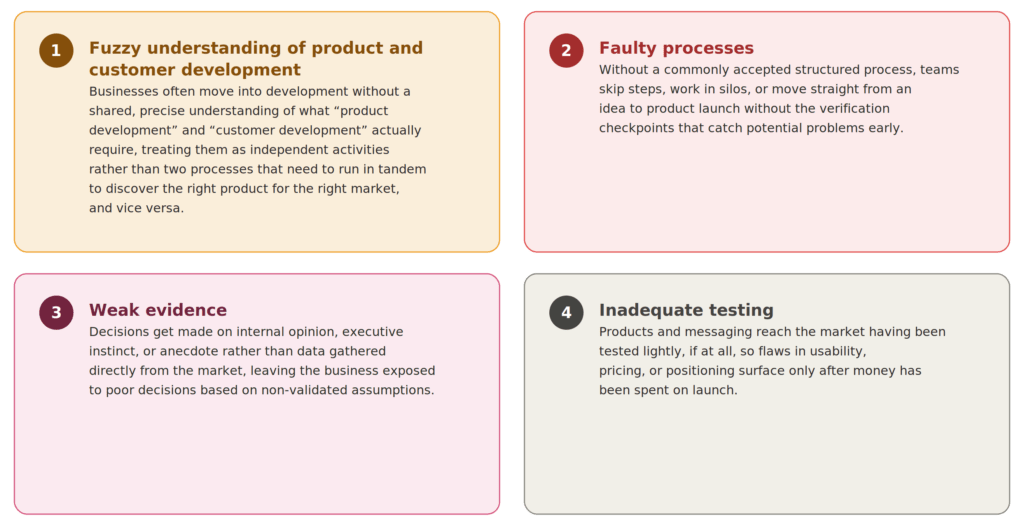
Left unaddressed, these four issues compound one another. A team with a fuzzy understanding of the task is unlikely to build a rigorous process; a weak process rarely generates strong evidence; and without evidence, testing becomes a formality rather than a genuine checkpoint.
The result shows up in the numbers: multiple industry studies place new-product failure rates for consumer goods somewhere between 25% and 40% within the first two years of launch, even after accounting for the more alarmist figures sometimes quoted in the press.
Rigorous, research-led development materially changes those odds. One 2025 analysis of global product launches found that products built on structured market research succeeded roughly three times more often than those launched primarily on non-validated internal intuition.
Solutions
The good news is that each of the four issues above has a corresponding, practical fix. None require exotic tools, they require discipline and an open entrepreneurial mindset.
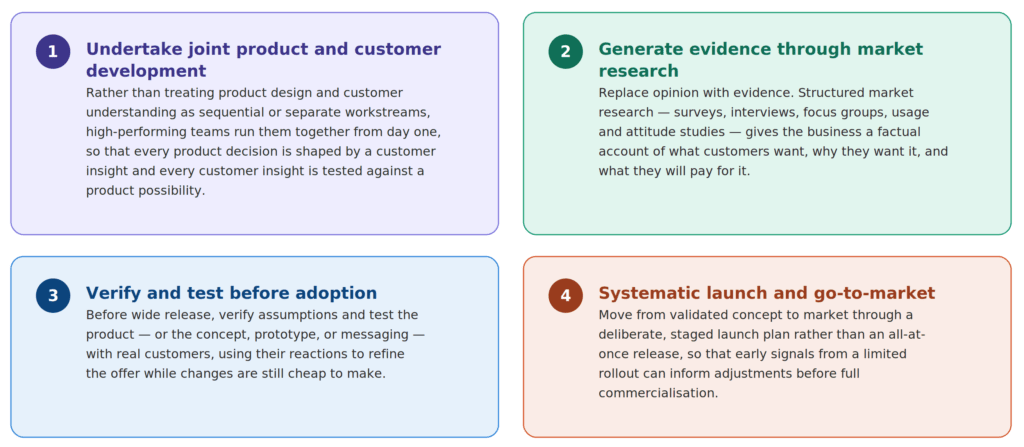
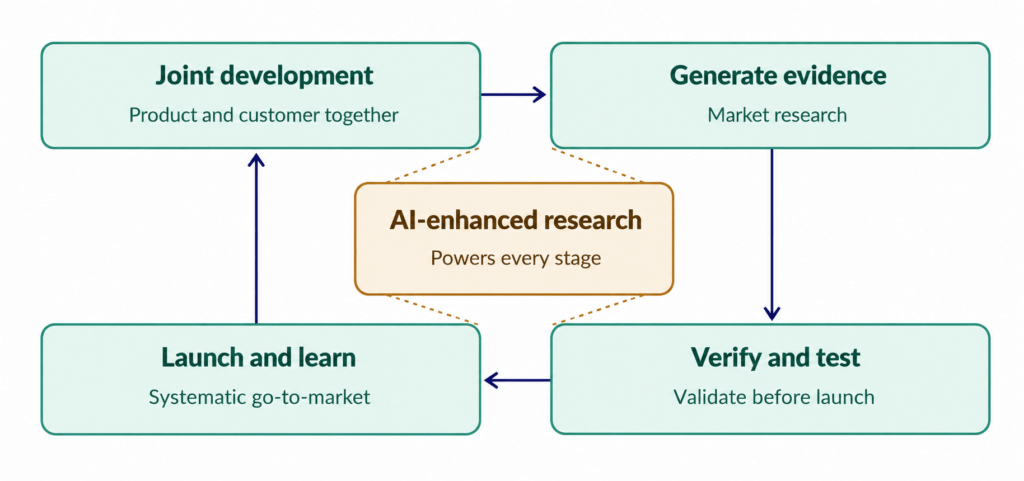
Together, these four practices form a loop rather than a straight line: research informs the product, testing validates the research, and the launch itself becomes a further source of evidence for the next iteration.
Adoption of AI-Enhanced Market Research
Market research is the engine that generates the evidence described above, and it plays a defining role at every stage of product and customer development, from early opportunity identification through concept testing to post-launch tracking. In recent years, that engine has been substantially upgraded by artificial intelligence.
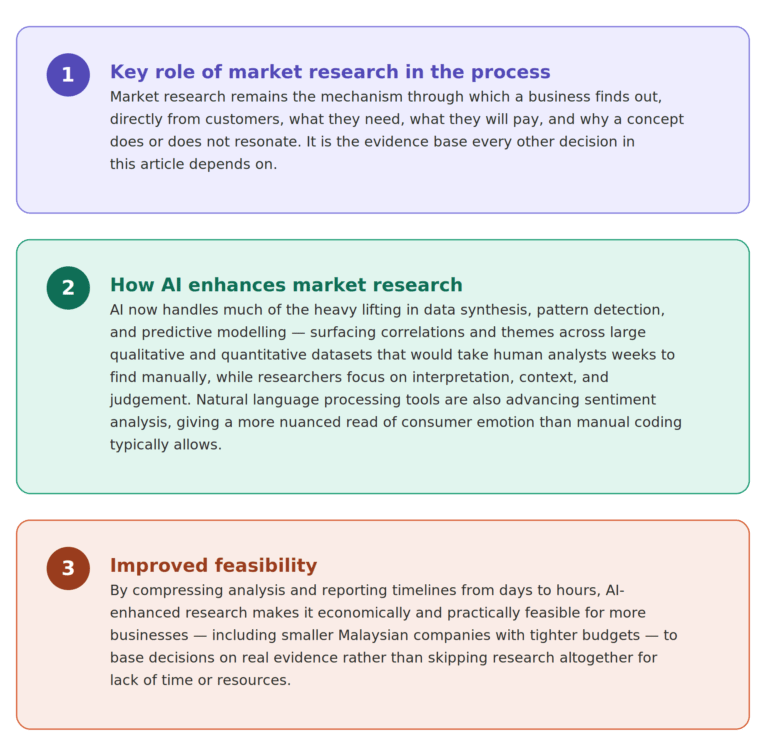
The direction of travel in the industry is consistent: AI is described as accelerating synthesis and scale while human researchers continue to own study design, interpretation, and recommendation. A hybrid model that most credible practitioners now regard as the strongest way to deliver both speed and rigour.
Potential Problems
None of this happens automatically, however. Even well-resourced businesses run into predictable obstacles when trying to build a joint, evidence-based, AI-enhanced approach.
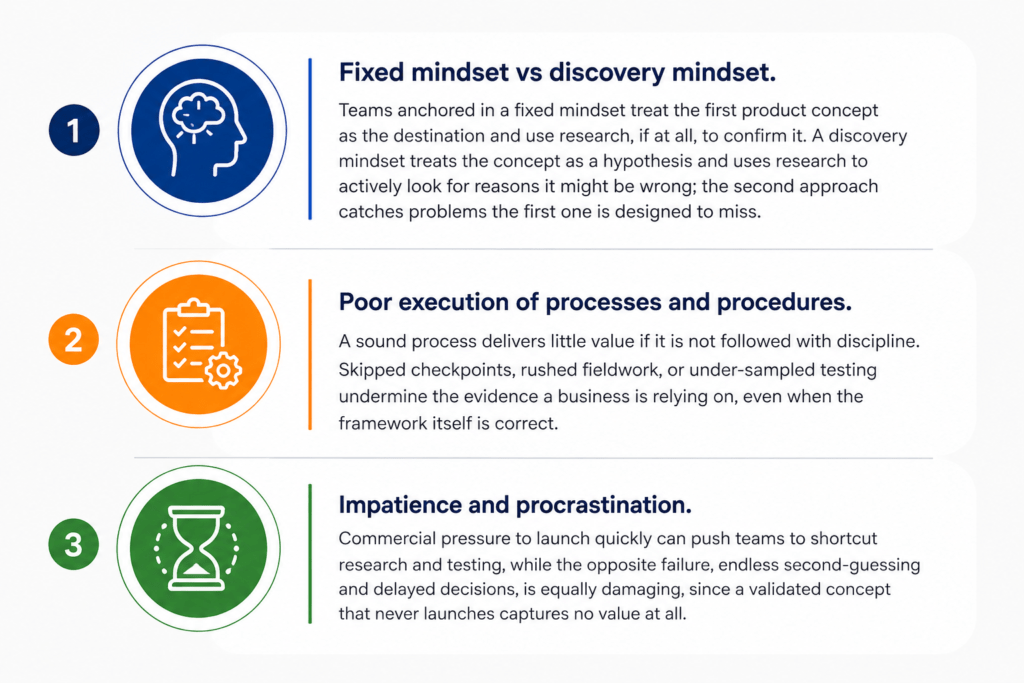
Anticipating these three failure modes is itself part of good process design:
- Build in structured checkpoints that force a discovery mindset
- Assign clear ownership for executing each research and testing step
- Set decision deadlines that discourage both rushing and stalling.
Key Takeaways
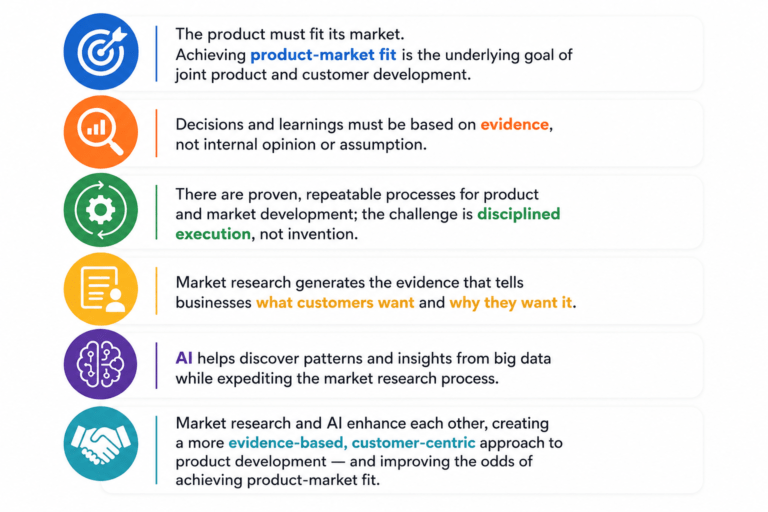
Product and customer development will always be twin challenges, two moving targets that must be hit together. What has changed is how much support businesses now have in hitting them: structured process, disciplined evidence-gathering, and AI-enhanced market research that makes rigour affordable at any company size.
Metrix Research is a Malaysia-based market research consultancy helping brands and businesses make better decisions through robust consumer insights and evidence-based research. Discover how we can help you measure and maximise your research impact by exploring our website or contact us today.
For more articles, please explore insights
References
- Drucker, P. (1954). The Practice of Management. New York: Harper & Row, p. 37.
- Drucker, P. F., as widely cited in management literature: “Because its purpose is to create a customer, the business enterprise has two — and only two — basic functions: marketing and innovation.”
- Industry analyses of new-product failure rates, including a Marketing Letters (2021) study of 83,719 consumer packaged goods SKUs, and subsequent industry commentary on product-market fit.
- Insights Consultancy (2025). Why Market Research Reduces Failed Product Launches.
- SME Corporation Malaysia (2024), as cited in academic literature on MSME performance in Malaysia.
- Study on New Product Development: The Perspective of SMEs in Malaysia, food and beverage sector, southern region.
- Malaysia SME (2026). Why Malaysian SMEs Are Trapped in Price Wars — And How Category Creation Can Drive Sustainable Growth.
- The Star (2026). Helping SMEs Scale Up — commentary on rising operational costs and margin pressure among Malaysian MSMEs.
- Fuel Cycle (2026). 2026 Market Research & Insights Trends Report.
- Ask Attest (2026). Key Market Research Trends for 2026: Insights and Strategies.
- Touchstone Research (2026). Top 10 AI-Powered Market Research Companies in 2026.