

Why Employees Affect A Company's Branding
How internal culture, employee behaviour and advocacy shape brand perception — with a Malaysian case study
Introduction
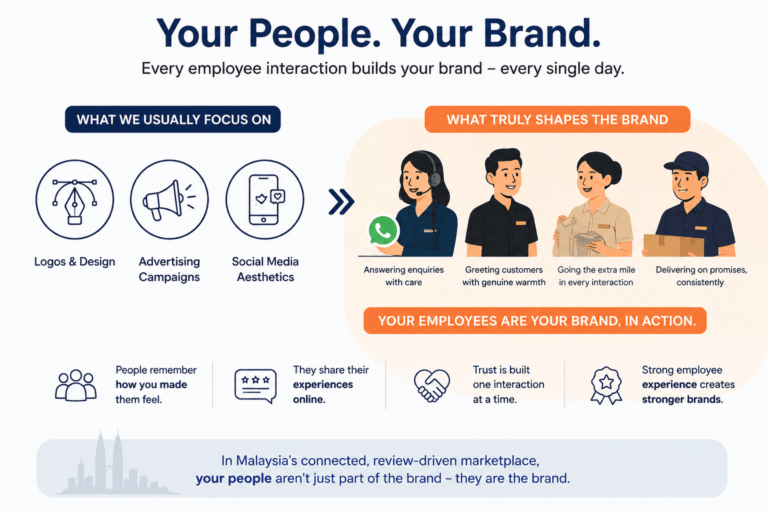
When Malaysian businesses think about branding, the conversation usually gravitates toward logos, advertising campaigns, and social media aesthetics. Yet one of the most powerful, and most overlooked, brand assets is already inside the organisation: its employees.
From the customer service officer answering a WhatsApp enquiry to the retail assistant greeting shoppers at a mall in Kuala Lumpur, every employee interaction quietly shapes how a brand is perceived.
In today’s connected, review-driven marketplace, a company’s people are no longer separate from its brand; they are the brand, in action.
Employees Are the “Moment of Truth” for a Brand
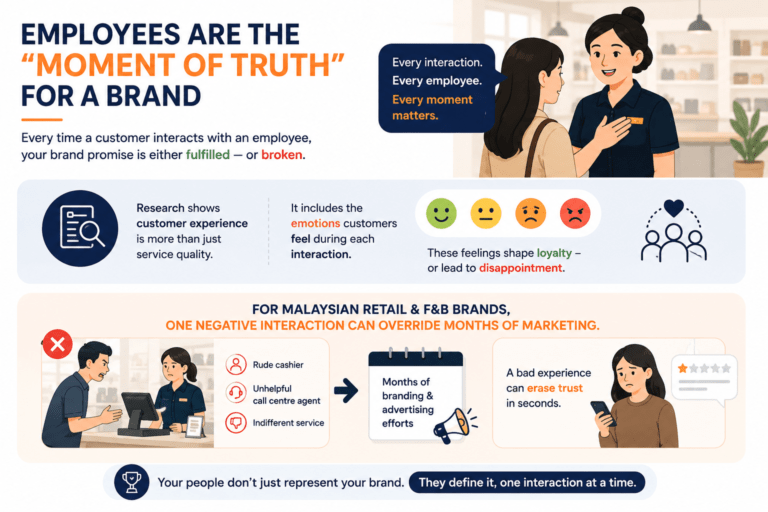
Marketing research describes every customer-employee interaction as a “moment of truth”, the precise point where a brand’s promise is either delivered or broken.
According to a study published in the International Journal of Research and Innovation in Applied Science, customer experience extends far beyond a rational assessment of service quality; it includes the emotions customers feel during each interaction, and these feelings ultimately drive loyalty or disappointment.
For a Malaysian retail or F&B brand competing in a crowded market, this means a single rude cashier or an unhelpful call centre agent can undo months of carefully crafted advertising.
Employee-Brand Alignment Builds Brand Equity
A landmark study published in the Journal of Marketing by Sirianni, Bitner, Brown, and Mandel introduced the concept of “branded service encounters”, situations where frontline employee behaviour is deliberately aligned with a company’s brand positioning.
Their research found that when employees embody the brand’s personality authentically, it measurably increases overall brand evaluation and customer-based brand equity, with the effect being even stronger for lesser-known or newer brands.
This is particularly relevant for Malaysian SMEs and growing companies that don’t yet have the brand recognition of established multinationals;
well-trained, brand-aligned staff can help close that gap faster than advertising spend alone.
Internal Culture Leaks Into External Perception
Branding doesn’t stop at the company’s front door. Research on employer branding shows that employees’ job satisfaction and sense of organisational identification directly influence how they speak about their employer, not just to prospective recruits, but to customers as well.
In other words, a happy, engaged workforce naturally becomes a word-of-mouth engine, while a disengaged one can quietly undermine a brand’s reputation, one conversation at a time. Locally, this pattern shows up in Malaysian HR literature. Guidance on staff engagement in Malaysia notes
that engaged employees tend to deliver better customer service, since their enthusiasm and grasp of company values make them more effective brand ambassadors.
Emotional Delivery Shapes Customer Perception
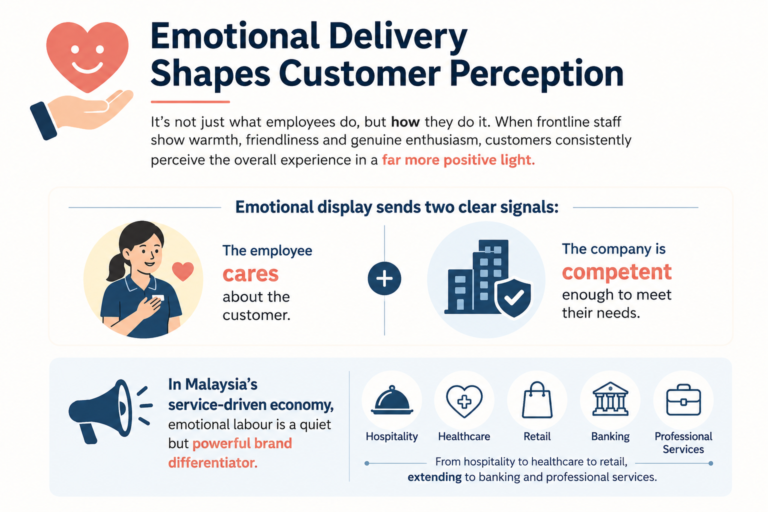
It’s not just what employees do, but how they do it. Studies across hospitality, retail, and healthcare consistently find that when frontline staff display warmth, friendliness, and genuine enthusiasm, customers report significantly more favourable perceptions of the overall service experience.
This emotional display signals two things simultaneously:
- That the employee cares about the customers
- That the company is competent enough to meet their needs.
For Malaysia’s service-heavy economy, from hospitality to healthcare to retail, extending to banking and professional services, this emotional labour is a quiet but powerful brand differentiator.
Employees as Everyday Brand Ambassadors
Social media has turned every employee into a potential brand spokesperson. A Harris Poll survey found that nearly half of adults (49%) view social media posts from everyday employees as more authentic than content from executives or official corporate accounts.
This authenticity translates into engagement: according to the 2021 Edelman Trust Barometer, employee social media posts generate roughly eight times more engagement than posts from company leadership.
For Malaysian brands looking to extend their reach organically, especially on platforms like TikTok and Instagram, which dominate local social media use, encouraging genuine employee advocacy can be far more cost-effective than paid influencer campaigns.
Employer Brand and Customer Brand Are Increasingly the Same Brand
Industry research increasingly treats employer branding and customer-facing branding as two sides of the same coin. A company’s reputation as an employer doesn’t just affect recruitment; it shapes how customers, investors, and other stakeholders perceive the business as a whole.
In practice, this means a company’s Glassdoor reviews, employee testimonials, and workplace culture stories are now part of its public brand narrative, whether the company actively manages them or not.
Malaysian Case Study: Grab's Culture-Driven, People-First Brand
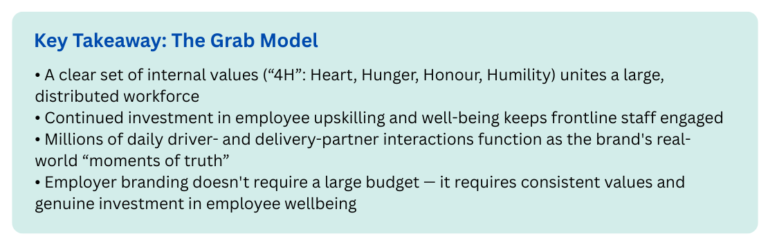
A more recent example of employee-driven branding in action is Grab, which began in Malaysia as MyTeksi back in 2012 and remains one of the most visible brand-through-people case studies in the market today. Grab anchors its internal culture around four values, Heart, Hunger, Honour, and Humility, known internally as the “4H” values — which the company describes as the foundation of how work, collaboration, and impact are driven across its Southeast Asian operations, including Malaysia. Rather than treating culture as a back-office HR initiative, Grab has continued investing in career development, employee well-being, and continuous learning — including a 2024 push to upskill employees on generative AI — as a deliberate way of keeping its workforce engaged and aligned with the brand.
What makes Grab particularly relevant to this article’s argument is scale: because so many Malaysians interact with Grab through its driver-partners and delivery-partners rather than a corporate storefront, these frontline individuals are effectively the brand’s face in millions of daily “moments of truth” — every ride, every food delivery, every in-app interaction. A friendly, professional driver-partner reinforces trust in the Grab brand far more powerfully than any advertising campaign could; a poor interaction does the opposite, instantly and publicly, often via a public rating or social media post.
Grab’s model is a useful contrast to more traditional employer-branding programmes: rather than a single named ambassador scheme, it demonstrates how a decentralised, values-led culture can turn an enormous frontline workforce into a brand’s most frequent customer touchpoint.
Reputational Risk: Brands Are Built Slowly, Broken Quickly
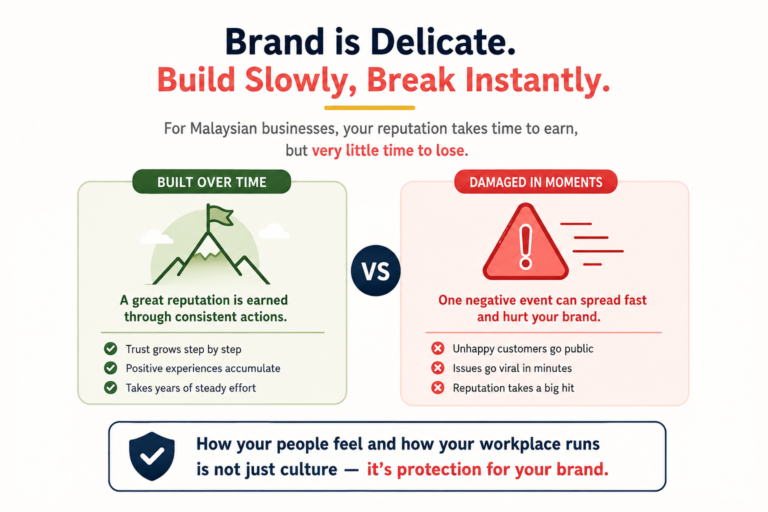
Perhaps the most important lesson for Malaysian business owners is the asymmetry of brand-building. A strong brand image takes years of consistent effort to build, but a single viral incident, a mistreated customer, a leaked internal message, a disgruntled ex-employee’s public complaint, can damage it in a matter of hours.
This makes employee experience and internal culture a genuine risk-management issue, not just an HR concern.
Conclusion
For Malaysian companies competing in an increasingly service-driven, digitally connected economy, employees are not a peripheral factor in branding; they are one of its most direct expressions. Investing in employee engagement, training staff to embody brand values authentically, and empowering employees to share their genuine experiences online are no longer “nice-to-haves.”
They are core branding strategies with measurable impact on how customers, investors, and future talent perceive the business.
Metrix Research is a Malaysia-based market research consultancy helping brands and businesses make better decisions through robust consumer insights and evidence-based research. Discover how we can help you measure and maximise your research impact by exploring our website or contact us today.
For more articles, please explore insights
Sources
- Sirianni, Bitner, Brown & Mandel (2013), “Branded Service Encounters: Strategically Aligning Employee Behavior with the Brand Positioning,” Journal of Marketing — sagepub.com
- RSIS International (2025), “The Impacts of Frontline Employee Emotional Awareness on Customer Experience”
- MDPI (2024), “Employer Branding: How Current Employee Attitudes Attract Top Talent and New Customers”
- Vouch (2026), “25 Employer Brand Statistics To Know”
- CO— by US Chamber of Commerce, “Why Employee-Generated Social Content Builds Trust With Customers” (Harris Poll data)
- Sociabble, “Brand Ambassador Program: Which Figures to Consider?” (Edelman Trust Barometer 2021)
- The Access Group (Malaysia), “Employee Engagement: A Guide to Improving Staff Involvement in Malaysia”
- Asia Responsible Enterprise Awards, “AirAsia — Hall of Fame 2017: Investment in People”
- AirAsia Newsroom, “AirAsia named one of Malaysia’s top employer brands”