

Building KPIs from Research Insights
A practical guide for turning market research findings into actionable, business-aligned performance metrics for Malaysian businesses.
Market research produces findings. Business performance requires metrics. The gap between the two, turning a well-written insight report into a KPI that a management team actually tracks every month, is where many organisations lose the value of the research they paid for.

This article sets out a practical framework for converting research insights into Key Performance Indicators (KPIs) that are specific, measurable, and genuinely tied to business outcomes, with particular relevance for Malaysian businesses navigating an increasingly digital and competitive market.
Why Research Insights Alone Aren't Enough
A common failure point in market research is treating the final report as the deliverable. In reality, the report is only useful if its findings are translated into something an organisation can act on and revisit over time. Integrating research-derived metrics into a broader measurement framework enhances transparency and ensures that every strategy stays aligned with overarching business objectives, rather than existing as a one-off exercise that gets filed away after the presentation. As digital interactions have grown, market research metrics themselves are evolving too, with newer measures such as customer digital engagement and sentiment scoring increasingly complementing — and in some cases replacing — traditional indicators.

For a business commissioning research, the practical implication is this:
Before the research even begins, it is worth asking not only “what do we want to learn?” but “what number will we track because of what we learn?”
Start With Business Objectives, Not Data
It is tempting to let the data dictate the KPIs, to look at what was measured and simply report it back as a metric. This is backwards.
Effective KPIs are aligned with the overall business strategy and cascaded throughout the organisation, beginning with strategic objectives set by senior leadership and only then developed into top-level KPIs that reflect those goals. Research insights should be mapped onto existing objectives, not used to invent new ones on the fly.
In practice, this means a research-to-KPI process should start with a simple question: which strategic objective does this metric serve? A customer satisfaction score, for instance, is meaningless as a floating number. Tied to a retention objective, it becomes a KPI with a clear reason for existing and a clear owner within the business.
Applying the SMART Framework to Research-Derived Insights
The most widely used discipline for converting a research finding into a workable KPI is the SMART framework. A well-designed KPI should be:
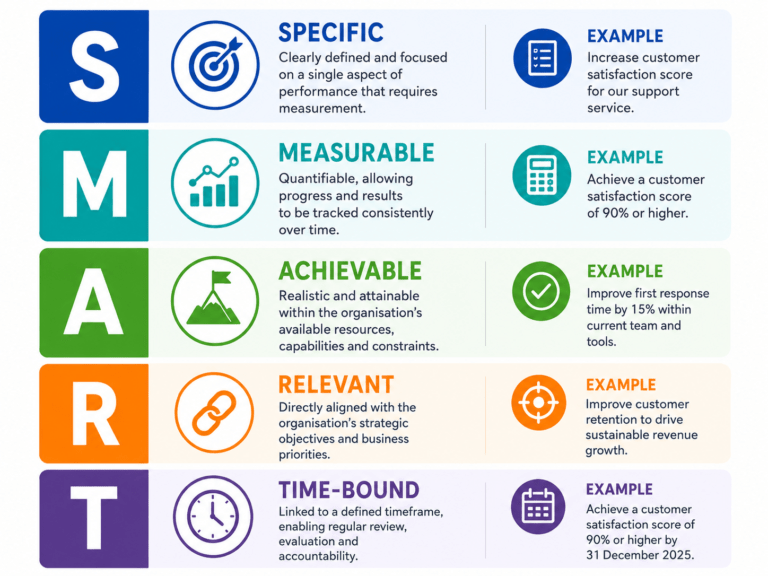
By applying the SMART framework, organisations can ensure that KPIs are meaningful, actionable, and capable of driving measurable improvements in performance
The payoff for doing this properly is measurable. Businesses that align their KPIs with strategic objectives are 2.5 times more likely to report significant improvements in performance, underlining that the discipline of building KPIs correctly is not a bureaucratic exercise, it has a direct bearing on results.
Where Good KPIs Come From: Research Methods That Surface Them
Not every KPI should come from a single dataset. A range of research methods typically feeds into identifying the metrics that matter most to a given business:
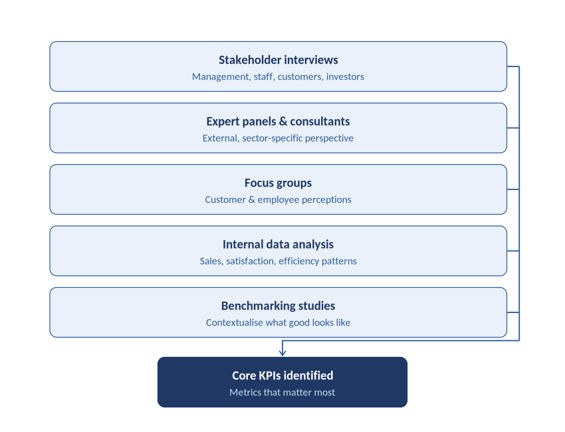
For most businesses, the strongest KPI frameworks draw on a combination of these:
- Qualitative input to establish what matters, and
- Quantitative data to establish how it should be measured.
Core KPI Categories to Consider
While every business’s KPI set should be built around its own objectives, a few categories recur across most market analysis and research-driven KPI frameworks.
Business performance KPIs, commonly include:
- Market share
- Customer acquisition cost
- Return on investment
- Customer lifetime value
- Conversion rate
- Engagement metrics.
Research quality and process KPIs, particularly relevant for organisations that rely heavily on ongoing research to inform decisions, include:
- Client or stakeholder retention rate
- Project delivery time
- Research accuracy, which ensures that the insights and data feeding into decisions remain reliable over time.
Redefining KPIs: From Output to Impact
There is a broader shift underway in how research-driven organisations think about KPIs. Historically, agencies and internal research functions have measured themselves by operational output, completion rates, cost per interview, and turnaround time. These remain useful, but they don’t fully capture the value delivered to the business.
There is a growing push for research functions to move beyond purely operational metrics toward KPIs that reflect insight utility, data reliability, and strategic value, in other words, measuring impact rather than activity alone.
For businesses building KPIs from research insights, this shift is a useful check: alongside the standard performance metrics, it is worth asking whether the KPI set also captures whether the insights being generated are actually driving better decisions, not just whether the research was delivered on time and on budget.
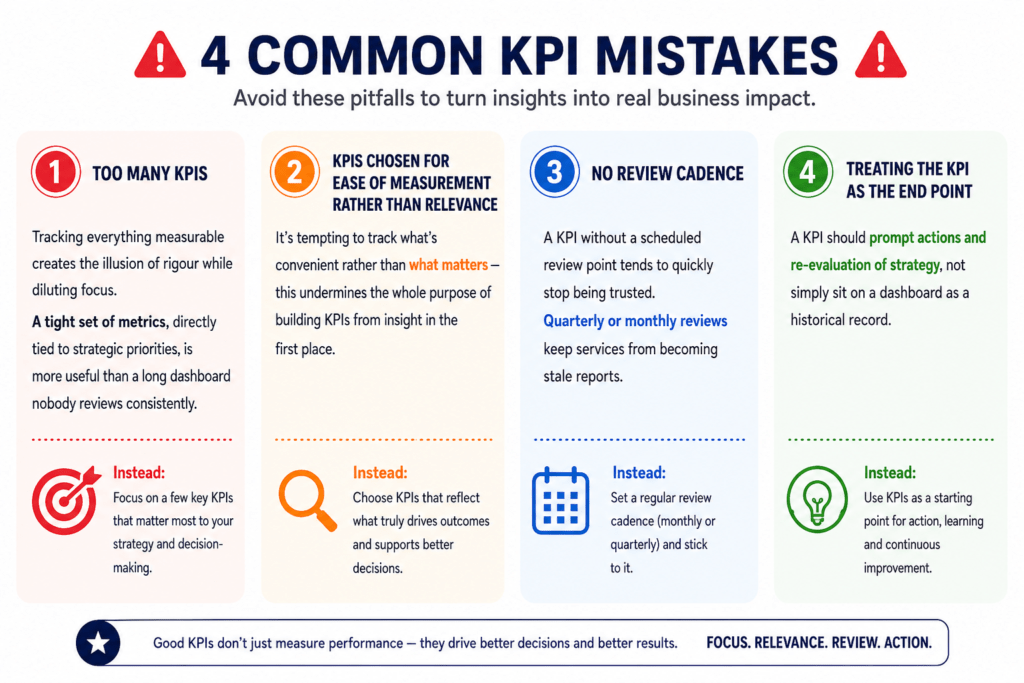
Common Pitfalls to Avoid
Conclusion
Research insight and business performance measurement are two different disciplines that need to be deliberately connected.
Starting from business objectives, applying the SMART framework with discipline, drawing KPIs from a mix of qualitative and quantitative research methods, and building in a regular review cycle are the practical steps that separate research that gets acted upon from research that gets filed away.
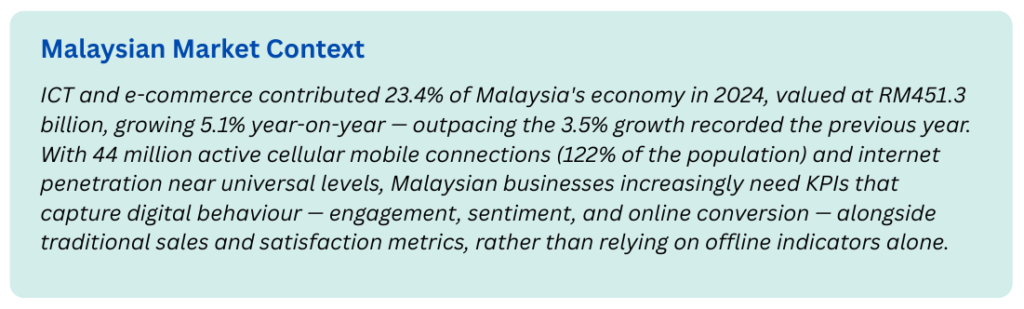
For Malaysian businesses operating in an increasingly digital, fast-moving market, building this connection well is no longer optional, it is central to how strategic decisions get made.

Metrix Research is a Malaysia-based market research consultancy helping brands and businesses make better decisions through robust consumer insights and evidence-based research. Discover how we can help you measure and maximise your research impact by exploring our website or contact us today.
For more articles, please explore insights
References
- NumberAnalytics. “7 Powerful KPIs in Market Research for Strategic Insights.”https://www.numberanalytics.com/blog/7-powerful-kpis-market-research-strategic-insights
- SIS International. “KPI Market Research.”https://www.sisinternational.com/expertise/industries/kpi-market-research/
- Modeliks. “Market Research and Analysis KPIs Dashboard.”https://www.modeliks.com/industries/professional-services/market-research-analysis-kpis-dashboard
- DataDiggers. “Redefining KPIs for Modern Research Agencies.”https://www.datadiggers-mr.com/blog/redefining-kpis-for-modern-research-agencies
- Luth Research. “Which KPIs Matter in Market Analysis?”https://luthresearch.com/glossary/which-kpis-matter-in-market-analysis/
- SpiderStrategies. “Unlocking Success: The Power of SMART KPIs.”https://www.spiderstrategies.com/blog/smart-kpis/
- SimpleKPI. “SMART KPIs & SMARTER KPIs: Examples & Implementation Guide.”https://www.simplekpi.com/Blog/smart-and-smarter-kpis-explained
- Crystal Consulting Group. “Understanding KPIs: The Basics.”https://crystalconsultinggroup.com/understanding-kpis-the-basics/
- Vorecol. “Measuring Success: KPIs in SMART Goal Frameworks.”https://vorecol.com/blogs/blog-measuring-success-key-performance-indicators-kpis-in-smart-goal-frameworks-183957
- Department of Statistics Malaysia (DOSM). “Malaysia Digital Economy 2025.”https://www.dosm.gov.my/portal-main/release-content/malaysia-digital-economy-2025
- DataReportal. “Digital 2026: Malaysia.”https://datareportal.com/reports/digital-2026-malaysia